
Short answer: How long does SEO take? It depends on the change: Google says some show in a few hours, others take several months, and suggests waiting a few weeks before judging one. Its page on hiring an SEO dropped its four months to a year range in June 2026, so track progress in order: indexed, impressions, clicks, then calls.
How long does SEO take? Google's current answer
There's no single number, and Google doesn't give one. Its SEO Starter Guide says every change takes some time to be reflected on Google's end: "Some changes might take effect in a few hours, others could take several months." It adds that you'll likely want to wait a few weeks to assess whether a change helped, and that not every change leads to a noticeable impact.
Bigger improvements take longer. Google's guide to core updates says some changes can take effect in a few days, but it could take several months for its systems to confirm that a site as a whole is producing helpful, reliable content. If a few months pass with no effect, that could mean waiting for the next core update. The same page says there's no guarantee your changes will lead to noticeable impact in search results.
So how long does SEO take? Long enough that you need something to watch in the meantime. SEO doesn't run on one timeline. It runs on several, one for each kind of change, and the useful question each month is which signal should move next. The rest of this guide sets out what to watch. If you'd rather have someone else watch it, monitoring and reporting is part of our SEO and content service.
Decide what working means before you start
For a local service business, SEO is working when people who didn't know your name find you in search and call, book or fill in a form. Rankings are a step toward that, not the goal. Write down the five or ten services and towns you most want to be found for, and the pages that should win each one. Every check later in this guide refers back to that list.
Google's SEO timeline: the number it no longer gives
For years, Google's page on whether you need an SEO included a range. A copy archived on May 20, 2026 still reads: "Remember that it will take time for you to see results: typically from four months to a year from the time you begin making changes until you start to see the benefits." The version Google updated on June 5, 2026 no longer includes that sentence or any other time range.
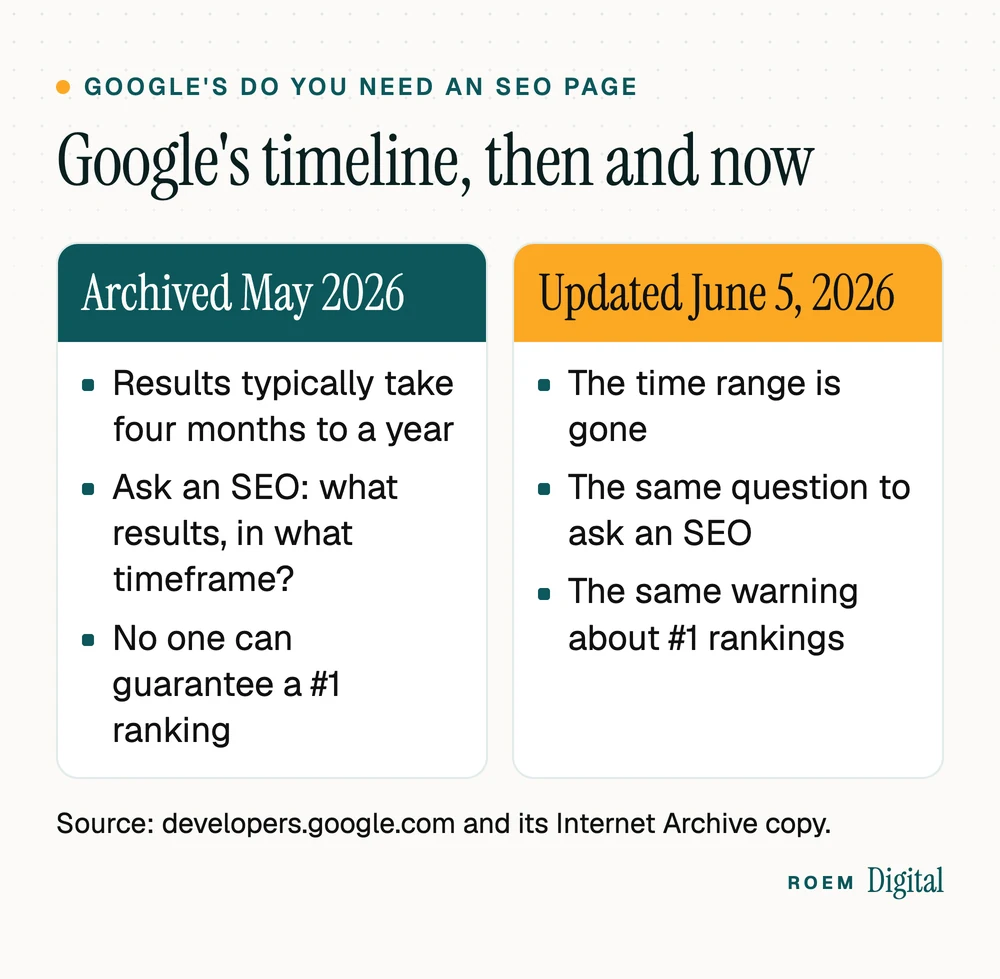
What the page still says is more useful. Among the questions it has long suggested asking an SEO: "What kind of results do you expect to see, and in what timeframe? How do you measure your success?" It says an audit should give you realistic estimates of improvement and of the work involved. And it's blunt about promises: "No one can guarantee a #1 ranking on Google." If someone guarantees first place, Google's advice is to find someone else.
Our reading: the old range still gets quoted around the web, but Google dropped the number and kept the question. Treat any timeline as an estimate tied to specific work, and ask how it will be measured. Our list of questions to ask a marketing agency covers the rest of that conversation.
How long does SEO take for each kind of change?
Each kind of SEO work waits on something different. Google's own documentation describes several of those waits:
| Change | What it waits on | What Google's documentation says |
|---|---|---|
| A new page title or main heading | Google recrawling the page | Noticing updates may take a few days to a few weeks. |
| A new page | Discovery, crawling and indexing | Crawling can take anywhere from a few days to a few weeks, and asking doesn't guarantee inclusion. |
| Moved URLs or a new domain | Google processing the redirects | A small to medium-sized site can take a few weeks for most pages to move. |
| Site-wide quality improvements | Google's systems reassessing the whole site | It could take several months, possibly until the next core update. |
| Reviews, links and reputation | Other people acting | No timeline. Google's local ranking help says more reviews and positive ratings can help local ranking. |
Where you start matters too. A brand-new site begins with nothing Google knows about: no indexed pages, no links pointing to it, no reviews tied to it. For a while, the first two signals below are the whole story. A site that already shows up for some searches has a head start, because changes to pages Google already knows only wait for the next crawl.
Then add the things only your situation decides: how much competition you have for the same searches, what shape the site is in when work starts, and how consistently the work gets done. A meta description rewrite and a 301 redirect sit at the quick end. Earning reviews and links sits at the slow end, because it depends on people outside your business. Google's local ranking help is where the review point comes from.
What to measure while you wait: four signals that come before rankings
Rankings are the last thing to settle and the easiest to misread. Track the signals that come before them, in the order they usually move. The order is our way of reading the reports, not a Google timeline: a page has to be indexed before it can be seen, seen before it can be clicked, and clicked before it can bring a call.
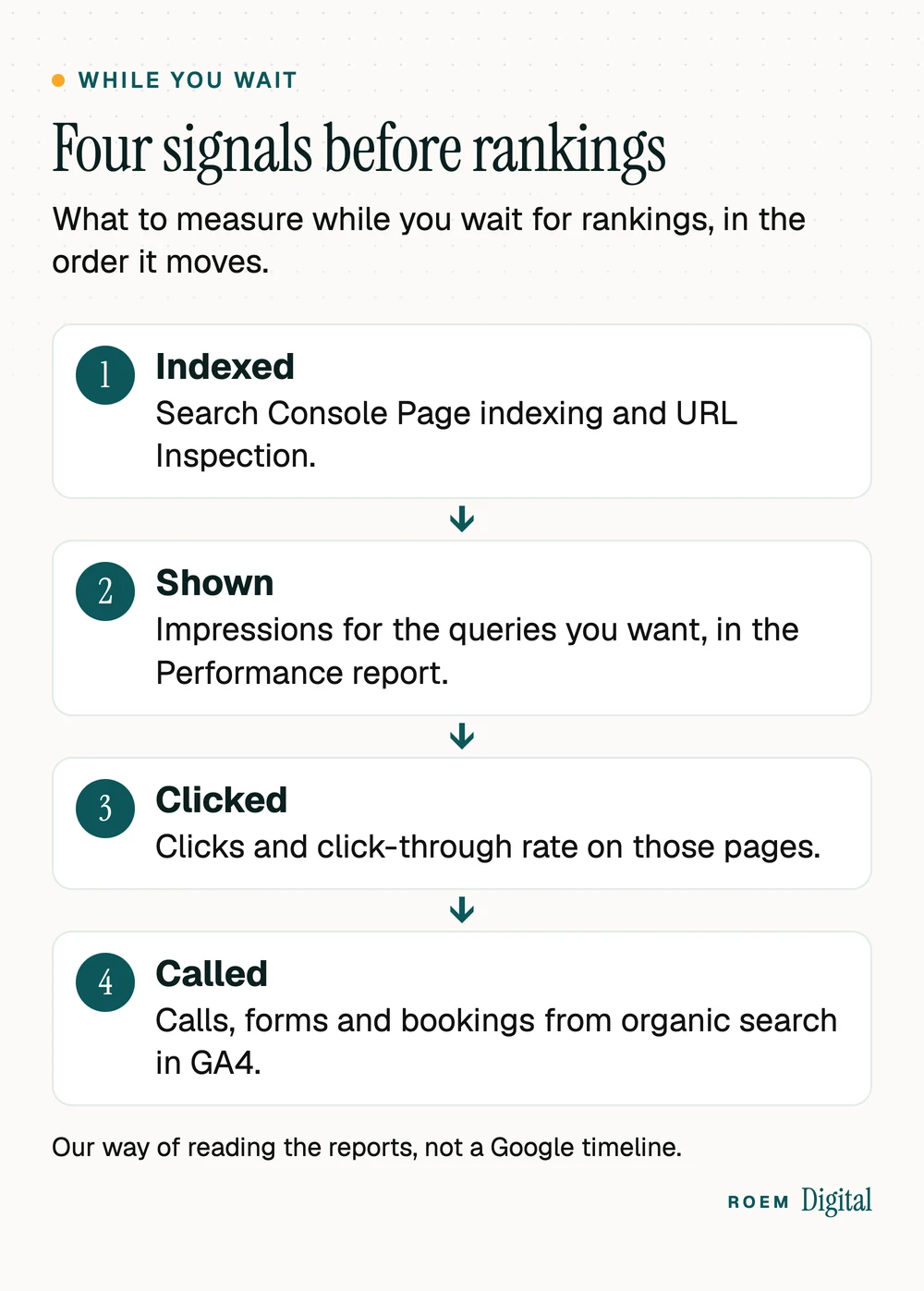
1. Is the page indexed?
Check the Page indexing report and URL Inspection in Search Console for the pages that matter. Google's Page indexing help says you shouldn't expect every URL to be indexed, only canonical pages, so focus on your service, city and contact pages. The same help page strongly recommends making sure your homepage is indexed, since Google should be able to reach the rest of a well-linked site from there. If a key page still isn't indexed a few weeks after publishing, URL Inspection will usually tell you why.
2. Is it showing up in search?
In the Performance report, filter to one page and read its queries and impressions. A page can't be clicked until it's shown, so impressions for the searches you want are the earliest sign the work is landing.
Don't judge this step by searching for yourself. Google's Performance report help notes that you might not see your site when you run a query yourself, because results depend on the time, place, device and recent history of the person searching. The report's numbers are the better guide.
3. Are people clicking?
Clicks and click-through rate show whether searchers pick you once they see you. Low clicks on high impressions usually point to the title and description, not the ranking.
4. Is it bringing calls?
Calls, form fills and bookings from organic search, recorded as key events in GA4. This is the signal that pays the bills. Our guide to tracking calls and form fills in GA4 shows how to set it up.
A monthly SEO progress check that doesn't depend on a deadline
Once a month, run the same five checks. They take the guesswork out of when you'll see SEO results, because you'll see each signal move, or not, on its own schedule.
- Read trends, not days. Google's Performance report help suggests weekly and monthly views for longer-term trends, because they smooth out daily swings like weekends and holidays.
- Compare with the same month last year if your business is seasonal. Our guide to the numbers every marketing report should show explains why.
- Separate your name from your services. Search Console's branded query filter splits searches that include your business name from those that don't, though Google says it isn't available for sites with a low number of impressions.
- Keep a dated change log. Write down what changed on which page and when, so you can match movement to work after the few weeks Google suggests waiting.
- Count leads by source: calls, forms and bookings from organic search, next to the same numbers from ads and referrals.

If you're new to Search Console, our Search Console guide walks through each report used above.
Should you keep paying for SEO? Signs to look for at each check-in
Waiting is part of SEO. Waiting without evidence isn't. At each monthly check, look for these:
| On track | Ask questions |
|---|---|
| New and changed pages are indexed within weeks. | Key pages still aren't indexed and nobody can say why. |
| Impressions grow for the searches you care about. | Reports show rankings for terms nobody searches. |
| Every report lists what changed and when. | The work is vague, or your provider won't explain what they're changing. |
| Leads from organic search are counted, even when small. | Nobody tracks calls or forms, so leads can't be counted. |
| Estimates come with a way to measure them. | Someone guarantees a ranking or a date for one. |
The last row builds on Google's own warning against SEOs who guarantee rankings, and its advice to be careful if a company is secretive or won't clearly explain what it intends to do. If you need calls this month, SEO alone won't deliver them on that schedule. Our comparison of Google Ads and SEO explains how many businesses use ads to cover the gap while organic search builds.
How we talk about SEO timelines with clients
We don't promise rankings or a date for them. You own your analytics accounts, so every number we report is one you can open and check yourself, and you can watch each of these signals for your own pages. If your current reports don't show the signals above, our guide to who owns your marketing accounts is a good first step.
Frequently asked questions
How long does SEO take to work for a new website?
Google's documentation doesn't give a fixed range. A new site first has to be discovered, crawled and indexed, and Google says crawling can take anywhere from a few days to a few weeks. After that, rankings depend on competition and content. Check that your key pages are indexed first, then watch impressions for the searches you want.
Did Google say SEO takes four months to a year?
It used to. An archived copy of Google's Do you need an SEO page from May 20, 2026 says results typically take from four months to a year. The version Google updated on June 5, 2026 no longer gives any range. It still suggests asking an SEO what results to expect, in what timeframe, and how success is measured.
Is it normal to see no SEO results after three months?
It depends on which signal you check. If key pages aren't indexed after three months, something needs fixing now. If they're indexed and impressions are growing but clicks aren't, work on titles and descriptions. Google says site-wide quality improvements can take several months to register, so judge progress by signals, not rankings alone.
Can I make SEO work faster?
You can remove delays, not skip the wait. Fix indexing problems first, submit a sitemap, and request indexing for important new pages, though Google says asking repeatedly won't get a page crawled any faster. If you need leads right away, paid search can bring calls while organic search builds.
Why did my rankings drop after I improved my website?
Some movement is normal. Google says rankings can fluctuate while it recrawls and reprocesses a changed site, and that positions in search results aren't fixed in place. Check that nothing broke: pages still indexed, redirects working, no stray noindex tags. If everything checks out, compare again after a few weeks before changing more.
What should a monthly SEO report show?
Which pages are indexed, impressions and clicks for the searches you care about, the leads that came from organic search, and a dated list of what changed. It should separate searches for your business name from searches for your services, and explain what comes next. Rankings alone, without leads, don't tell you much.