
Short answer: Auction marketing means getting registered bidders to each sale and the next consignor to call after it. Lead with standout lots, list the sale where bidders search, email your bidder list, run ads inside your pickup radius, and put your state's required license lines in every ad.
How to market an auction: lots, lists and the lines every ad needs
Auction marketing is the work of getting registered bidders to a sale before it closes, and getting the next consignor to call after it does. Each sale is a short campaign with a hard deadline, so the order you do things in matters as much as the channels you pick.
For a single sale, the essentials are short: photograph the standout lots first, publish the catalog and a sale page, list the sale where bidders already search, email your bidder list, run ads inside a realistic pickup radius, and put your state's required license lines in every ad. Then, once the sale closes, turn the results into the pitch for the next consignment.
Your website does a lot of this work between sales, and we cover that side on our auction company marketing page: a homepage that works when no sale is open, a past-auction archive and a consignor page. This post is about promoting one sale at a time, plus the ad rules most auction marketing guides skip.
Auction marketing from signed contract to pickup
Every auction passes through five stages, and each one has one marketing job. Miss a stage and you either pay for ads after bidding has closed or start the next sale with nobody new on your list.
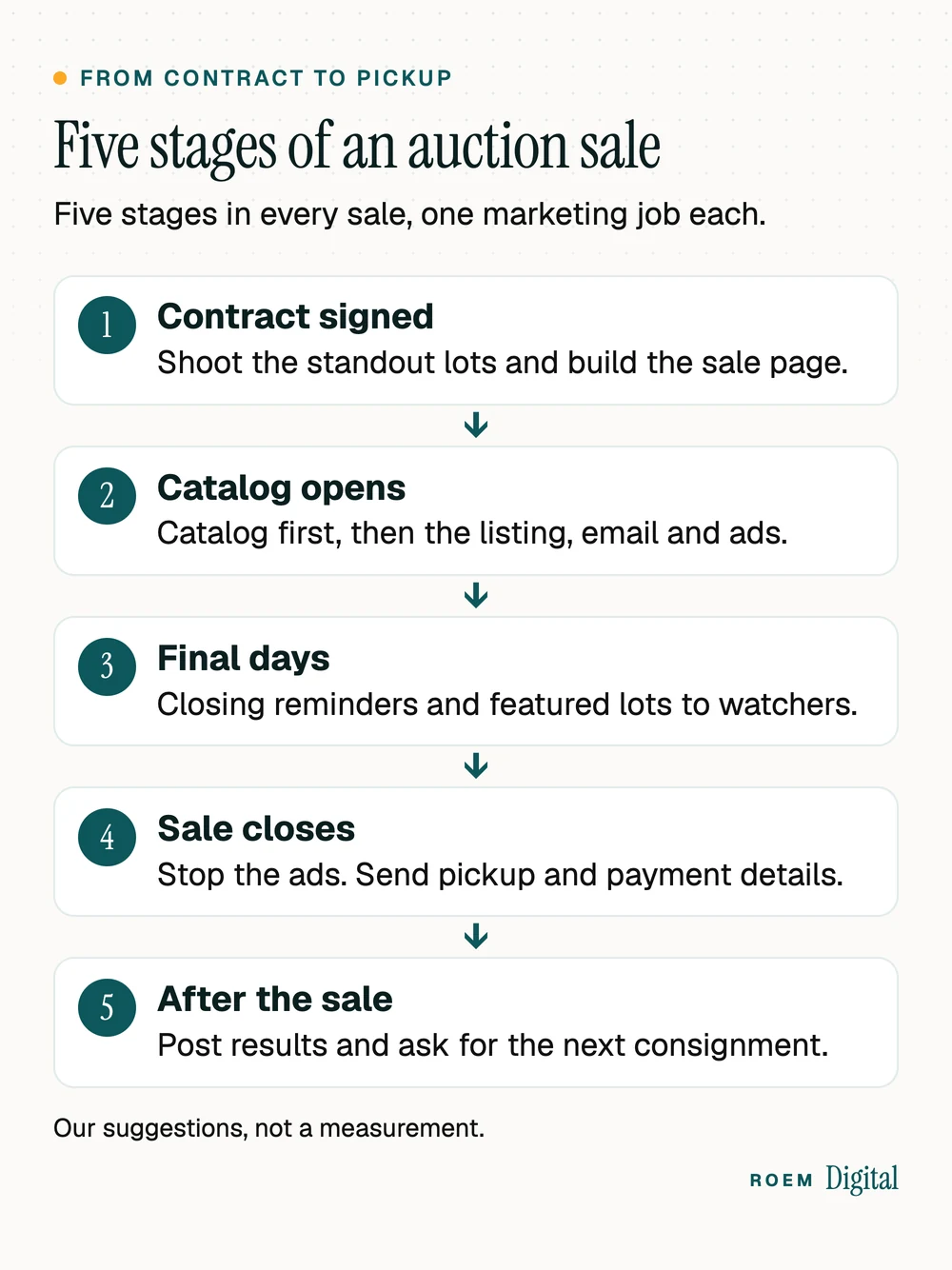
- Contract signed. Pick the five to ten lots that will carry the ads, shoot them first, and start the sale page with dates, preview, pickup and terms.
- Catalog opens. Publish the catalog on your bidding platform, then list the sale elsewhere, send the announcement email and start the ads. Every ad points to your own sale page.
- Final days. Send a closing reminder by email, and by text to people who opted in. Our SMS marketing guide covers the consent rules.
- Sale closes. Switch off the ads the moment bidding ends, and send winners clear pickup and payment details.
- After the sale. Post results on your site, thank bidders, and ask sellers for a review and for their next estate or collection. Our guide to getting more Google reviews has a request you can adapt.
The email steps are the cheapest part of the plan, because your bidder list already registered and paid at a past sale. Our guide to email marketing for small businesses covers the list rules and what to send.
Auction advertising ideas that bring in registered bidders
Most auction advertising ideas fall into three groups: places bidders already search, people who already know you, and ads that reach new bidders near you. Use the costs below as published by each platform, and check them again before you budget, because platforms change their fees.
| Idea | Best for | Published cost or note |
|---|---|---|
| Your own sale page | Every sale, and every ad's destination | You own it, and it keeps working after close |
| AuctionZip listing | Bidders browsing upcoming sales by area | $20 per auction listing, plus $150 to upgrade to Featured, per AuctionZip's publishing FAQ |
| HiBid catalog | Online, webcast and absentee bidding | Listed on Auction Flex's HiBid pricing page as "Auction Fee 2%" (the page doesn't say what the 2% is charged on, so ask HiBid), plus $0.25 per unique bid capped at $150 per auction and $75 per webcast |
| Email to your bidder list | Repeat bidders and category collectors | Your list, no per-sale fee |
| Facebook and Instagram ads | Pickup sales within driving distance | A budget you set per sale |
| Google search ads | Standout brands and categories in the catalog | Pay per click, a budget you set |
| Sale bills, signs and local papers | Farm, estate and rural sales | Print and placement costs |
One order-of-operations tip saves money. AuctionZip's FAQ says that if you offer live online bidding, post your live catalog first and let it generate your listing, you won't pay the separate $20 listing fee, while a listing created manually before the catalog is published is charged. The same FAQ treats each day of a multi-day sale as its own listing, though its own example prices a three-day auction at $20, so confirm the total with AuctionZip before you budget.
For paid ads, the main choice is between social ads that show your best lot photos to people nearby and search ads for people already hunting for a brand or category. Our comparison of Meta ads and Google Ads for local businesses walks through that choice. Tag every link with UTM parameters so the report shows which ad sent registered bidders, not just clicks.
Florida and Wisconsin auction ad rules: what every ad has to say
Many states regulate what an auction ad must include. Two examples show how specific the rules get. Florida's section 468.388 says all advertising by an auctioneer or auction business must include the name and Florida license number of the auctioneer and the auction business. Clothing, directional signs and promotional novelty items don't count as advertising.
The same subsection lists what makes an ad false or misleading, including leaving out those names and license numbers, advertising an auction as absolute without specifying every item sold with reserve or minimum bids, and leaving out the percentage of any buyer's premium or surcharge that is a condition of sale. It applies to media exposure of any nature, paid or not, and it makes the auction business responsible for the content of its advertising.
Wisconsin splits its rule between a statute and the auctioneer board's code. Section 480.20 says no one may advertise that an auction will be conducted unless the ad names the auctioneer and any auction company managing the sale, and states that the auctioneer is a "registered Wisconsin auctioneer". The board's rule, SPS 123.03, adds the auctioneer's state registration number, the terms on which buyers can pay, and the percentage or amount of any buyer's fee or surcharge that is a condition of sale.
| Ad line | Florida 468.388 | Wisconsin 480.20 and SPS 123.03 |
|---|---|---|
| Auctioneer's name | Required, with Florida license number | Required, with state registration number |
| Auction company's name | Required, with Florida license number | Required for any company managing the sale |
| Status statement | No separate statement | "Registered Wisconsin auctioneer" |
| Payment terms | Not addressed in 468.388 | Required |
| Buyer's premium | State the percentage if it's a condition of sale | State the percentage or amount of any buyer's fee or surcharge |
| "Absolute" auction | List every item sold with reserve or minimum bids | Not addressed in these sections: ask DSPS |
| Unpaid posts | Covered: media exposure of any nature | Both cover all advertisements of an auction |
The practical fix is a template. Put the required lines in your ad copy, social graphics, email footer and sale page once, and every new sale inherits them. Even where a state doesn't require it, stating the buyer's premium up front saves you from angry winners at checkout. If you sell in Central Florida, our Orlando auction marketing page explains how we build the license lines into templates. This is general marketing information, not legal advice.
Estate sale marketing is a different job from auction marketing
An estate sale usually means a tagged, fixed-price sale inside the home, open for a few days, with buyers lining up at the door. There's no bidding deadline to build toward. Estate sale marketing is about the start time, the photos and the rules at the door, and most of the audience lives within a short drive.
- Show the rooms, then the best pieces. Buyers decide whether the drive is worth it from a few wide shots and close-ups of standout items.
- Keep private life out of the photos. Crop out family photos, mail, prescription bottles, documents, alarm panels and the house number.
- State the rules plainly: dates, hours, how entry works on the first morning, payment methods, parking and whether you hold items.
- Reach the neighborhood. Local groups and neighborhood apps work well here, and our guide to Nextdoor for business explains what businesses can post there.
If the family chooses an auction instead, the five stages above apply, and the consignment conversation starts with the same questions: what's in the house, how soon it must be cleared, and who decides.
When to call the licensing board or an attorney before an ad runs
Most sales need nothing more than a good template. Talk to a professional before the ad runs when a sale has unusual terms, such as:
- An "absolute" auction where any item carries a reserve or minimum bid
- An apprentice calling the sale (Florida's statute requires the sponsor's name and license number in that case)
- Real estate in the catalog, or bidders and items crossing state lines
- A complaint from a bidder or consignor about an ad you ran
In Florida, the Board of Auctioneers licenses and regulates auctioneers. In Wisconsin, auctioneers and auction companies are credentialed through the Department of Safety and Professional Services. For anything that turns on your contract or your liability, ask an attorney who knows your state's auction law. And if you hire a marketing agency, ask how they handle license lines before they write a single ad. It's one of the questions to ask a marketing agency that matters more in this trade than most.
How ROEM helps auction companies market every sale
We built the website for Dorshorst Auctions, a full-service auction house in Deerfield, Wisconsin. Its homepage is designed for the weeks between sales as much as the week a catalog is open, with a clear path to sell and a link to the latest results.

We're a small senior team based in Davenport, Florida, and we work with clients across Central Florida and nationwide by video. For an auction company, that means a hand-built site around your sales, sale pages and email templates with the license lines built in, paid ads for each sale that stop when bidding does, and tracking that counts registered bidders. You own the domain, the site, the ad accounts and the bidder list.
Frequently asked questions
What should an auction ad include?
The sale dates and closing time, preview and pickup details, where to bid or register, a few standout lots with photos, payment terms and the buyer's premium. Add the lines your state requires, such as the auctioneer's and company's names and Florida license numbers, or in Wisconsin the registered Wisconsin auctioneer statement and registration number.
Do Florida auction ads need a license number?
Yes. Florida Statutes section 468.388 says all advertising by an auctioneer or auction business must include the name and Florida license number of the auctioneer and the auction business. Clothing, directional signs and promotional novelty items are excluded. The rule covers paid and unpaid media alike. This is general information, not legal advice.
What does Wisconsin require in auction advertising?
Wisconsin Statutes section 480.20 and the board's rule SPS 123.03 say an auction ad must name the auctioneer and any auction company managing the sale, state that the auctioneer is a registered Wisconsin auctioneer with the state registration number, give the payment terms and state any buyer's fee or surcharge. This is general information, not legal advice.
How much does it cost to list an auction on AuctionZip?
AuctionZip's publishing FAQ lists $20 per auction listing, with no per-item fee, and $150 more to upgrade to a Featured Listing. Multi-day sales are treated day by day, so confirm the total for yours. If you offer live online bidding and let your live catalog generate the listing, the FAQ says the $20 fee doesn't apply.
Should the buyer's premium be in every auction ad?
In Florida, leaving out the percentage of a buyer's premium that is a condition of sale makes an ad misleading under section 468.388, and Wisconsin's rule SPS 123.03 requires the percentage or amount of any buyer's fee or surcharge. Elsewhere, stating it is still good practice, because bidders who learn about it at checkout feel misled.
How is estate sale marketing different from auction marketing?
An estate sale is usually a fixed-price sale in the home over a few days, so marketing centers on the start time, room photos, entry rules and the local neighborhood. An auction builds toward a bidding deadline, so it relies on the catalog, bidder emails, closing reminders and ads that stop at close.