
Short answer: An AI SEO agency should do ordinary SEO well and make your business easy for AI tools to quote: indexed pages, direct answers, consistent details and real reviews. Google says optimizing for generative AI search is still SEO, and OpenAI says ChatGPT placement is not guaranteed, so anyone promising AI citations is overselling.
What an AI SEO agency should actually do for you
An AI SEO agency does ordinary SEO well and makes your business easy for AI tools to find, read and quote: pages Google can index, direct answers, business details that match everywhere, and reviews that say what you do.
The label covers two different things, and proposals often blur them. Some agencies mean they use AI tools to do SEO work faster: research, drafting, audits. Others mean they'll get your business into the answers that Google, ChatGPT and Perplexity give. Some mean both. Ask which one you're paying for. The first is a production method and the second is a goal, and only the goal changes what you should expect to see.
Google is plain about the goal. Its guide to optimizing for generative AI features, last updated July 10, 2026, says that from Google Search's perspective, "optimizing for generative AI search is optimizing for the search experience, and thus still SEO." Its page on AI features and your website says there are no additional requirements to appear in AI Overviews or AI Mode, nor other special optimizations necessary. Its newer guide adds one condition: the site must stay included in Search Console's generative AI setting, which is the default.
So a good AI SEO agency is a good SEO agency that also checks how AI tools describe you. That's how our SEO and content service treats it. If you want the how-to side, our guide to showing up in AI search covers the writing and technical setup. This post is about hiring someone to do it.
What AI search tools ask of your website, in their own words
Each company publishes what it needs from your website, and none of it is exotic. Here's what their own documentation said when we opened it on November 25, 2026:
| AI search tool | What it asks of your site | What it says about results |
|---|---|---|
| Google AI Overviews and AI Mode | A page that is indexed and eligible to show in Google Search with a snippet, on a site left included in Search Console's generative AI setting (the default). No special schema and no AI text files. | Indexing and serving aren't guaranteed, and AI Overviews often don't trigger. |
| ChatGPT search | Allow OpenAI's search crawler, OAI-SearchBot, and let OpenAI's published IP addresses through your host or CDN. | ChatGPT ranks results using multiple factors, and placement is not guaranteed. |
| Perplexity | Allow PerplexityBot and its published IP ranges. Perplexity says the bot is designed to surface and link websites in its search results. | Nothing about ranking: the page covers crawler access only. |
Notice what's missing. No tool asks for a special AI file, a new kind of markup or pages written in an odd format. Google's guide says that for Google Search you can ignore tactics like chunking content, creating unnecessary AI text files such as llms.txt, or pursuing inauthentic mentions. Our llms.txt guide looks at who actually requests that file.
What all three share is access. A security setting or robots.txt rule that blocks these crawlers takes you out of the running before content matters. OpenAI's crawler documentation says sites opted out of OAI-SearchBot won't be shown in ChatGPT search answers, though they can still appear as navigational links.
What no AI SEO agency can promise about ChatGPT or AI Overviews
Only the companies that run these tools decide what goes in the answers. OpenAI's help page on searching the web with ChatGPT says ChatGPT ranks results using multiple factors and that "placement is not guaranteed." Google's AI features page says AI Overviews appear only when its systems decide they add to classic Search, and as such often don't trigger. A page can meet every requirement and still not be shown.
The answers also vary. Google says AI Mode and AI Overviews may use different models and techniques, so the responses and links they show will vary. OpenAI says ChatGPT may rewrite a question using your approximate location and, if memory is on, saved details. Two people asking the same thing can get different businesses.
So treat a promised AI citation the way Google treats ranking promises. Its page on whether you need an SEO, updated June 5, 2026, says: "No one can guarantee a #1 ranking on Google." The same page suggests checking whether anyone offering AEO or GEO services gives advice aligned with Google's official guidance on optimizing for generative AI features.
What an honest agency can promise is the work: pages that are crawlable and indexed, answers stated plainly, details that match across the web, and a report that shows what moved. Our post on how long SEO takes explains why any date for results is an estimate, not a commitment.
Five questions that separate AI SEO work from AI SEO hype
Our view, as judgment rather than data: you're not buying a new channel, you're buying SEO with one more thing to check. These five questions test whether a proposal understands that. They're specific to AI search. For the general ones, see our list of questions to ask a marketing agency.
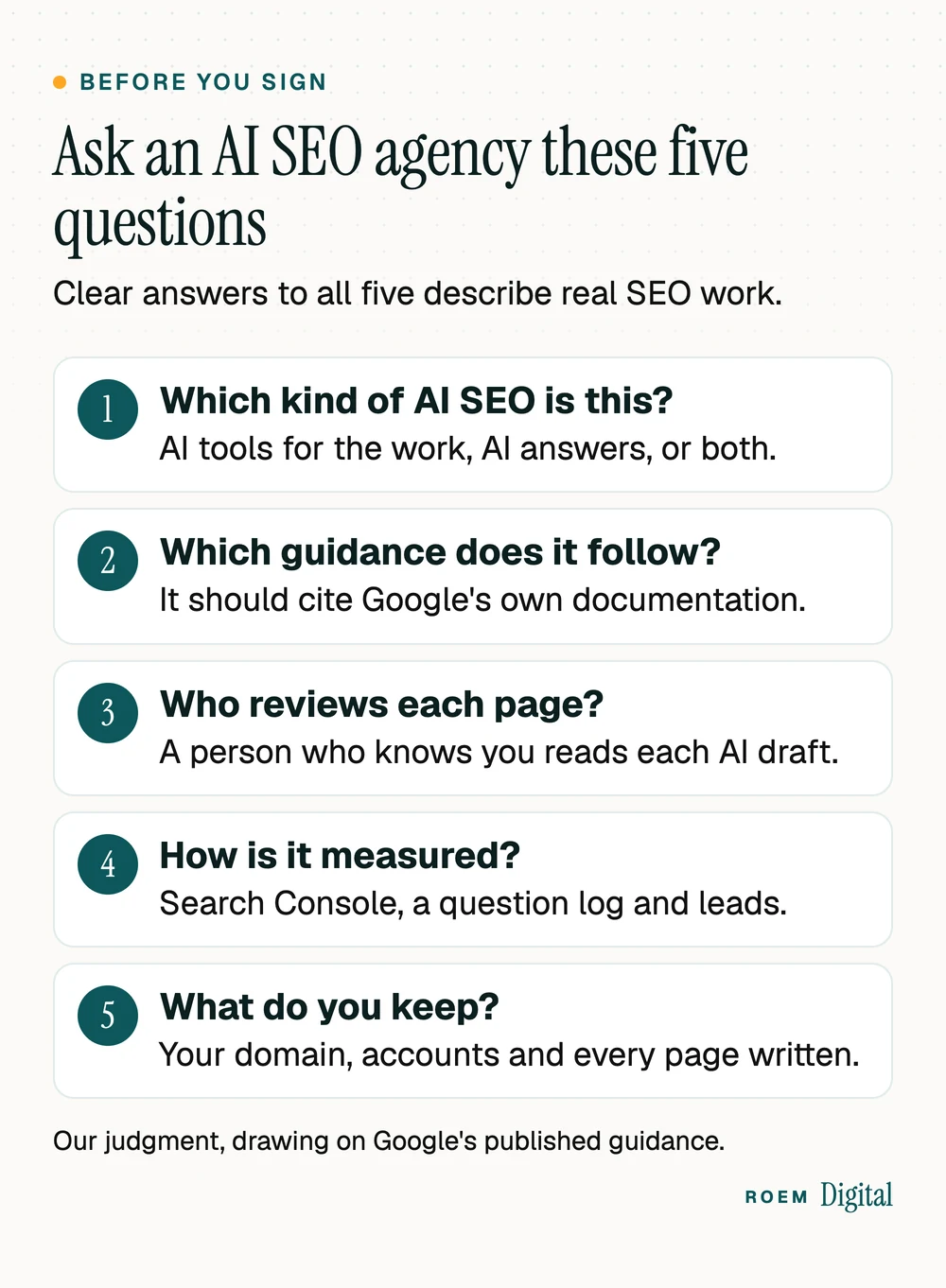
- Which kind of AI SEO is this? AI tools speeding up the work, visibility in AI answers, or both. Each one needs a different deliverable.
- Which official guidance does your advice follow? Google's own hiring page suggests asking whether an SEO cites official Google documentation, and whether AEO or GEO advice lines up with its guidance on generative AI features.
- Who checks AI-written pages before they go live? Google's guidance on using generative AI content says generating many pages without adding value for users may violate its scaled content abuse policy. Ask who reviews each page.
- How will you measure AI visibility? Expect Search Console's generative AI report for Google, a fixed set of customer questions checked by hand everywhere else, and leads counted by source.
- What do I keep if we stop? Your domain, website, Search Console, analytics and every page written should be yours. Our guide to who owns your marketing accounts lists what to check.
Red flags in an AI SEO proposal
Most of these run straight into rules that Google and OpenAI publish. If a proposal leans on one of them, ask for the source behind it.
| What the proposal says | What the published rules say |
|---|---|
| Guaranteed placement in ChatGPT or in Google's AI Overviews | OpenAI says ChatGPT placement is not guaranteed. Google says indexing and serving aren't guaranteed. |
| Hundreds of AI pages a month, one for every way people might phrase a question | Google's guide says making separate content for every query variation, mainly to manipulate rankings or AI responses, violates its scaled content abuse policy. |
| Hidden text or instructions on your pages aimed at AI tools | Google's spam policies, updated November 23, 2026, count attempts to manipulate generative AI responses in Search as spam, and list hidden text meant to manipulate search engines as abuse. |
| You need llms.txt or special AI schema to show up in Google | Google says Search ignores llms.txt and that no special schema.org markup is needed for its AI features. |
| We'll get you mentioned on hundreds of sites | Google says seeking inauthentic mentions isn't as helpful as it might seem, and its link spam policy covers buying links for rankings. |
| Our tool reads Google's internal AI ranking data | Google says no third-party tool has access to its internal ranking or AI systems. |
Bulk AI pages deserve a closer look, because they're the cheapest thing to sell and the easiest to count. Our post on AI slop shows what thin AI content looks like on a small business website and how to clean it up.
How to measure AI visibility honestly
Agree on the method before you sign, or every report turns into a debate. For Google's own AI features you now get real data, once your site has enough AI impressions for the report to appear. The generative AI performance report in Search Console, rolled out to all websites as of August 31, 2026, shows how often links to your site appeared in AI Overviews and AI Mode, by page, country, device and date.
Check one setting while you're there. Search Console's generative AI control lets a site owner exclude a site from Google's generative AI features. Including your site is the default, but if anyone switched it to exclude, you won't receive traffic or impressions from those features.
Outside Google, you're measuring by hand. A fair method looks like this:
- Write 10 to 20 questions a customer would really ask, with your service and town in them.
- Ask each one in ChatGPT, Perplexity, Gemini and Google once a month, worded the same way every time, signed out where the tool allows it so saved memories don't shape the answer.
- Log the result for each tool: named, cited with a link, or left out, and whether the details are right.
- Fix wrong details at the source: your website, your Google Business Profile and your listings.
- Count the calls, forms and bookings that follow. A citation that brings no leads isn't the goal.

Read the log as a trend, not a score. A single answer can change from one day to the next, so a pattern across your whole question list says more than any one screenshot. Our guide to showing up in AI search shows a simple spreadsheet for this log. What a monthly report should show alongside it is covered in our guide to monthly SEO services.
Expect to pay for this as part of SEO, not twice. In a pricing survey SE Ranking and Duda published in December 2024 of 170 agencies, 61% planned to add optimization for AI Overviews and other AI engines, most of them inside existing services rather than as an extra. Agencies that had settled on a price for it charged, or planned to charge, an average of $937 a month. Our guide to what SEO costs puts that figure in context.
How we handle AI search in our SEO work
We don't sell AI search as a separate product. It's part of how we do SEO and content: direct answers near the top of key pages, structured data that matches what's on the page, and business details that agree across your site, Google Business Profile and listings. We check whether AI tools name you for your main services and adjust from there.
Our small senior team does the work itself, with no hand-offs to juniors, and you own your domain, website and analytics. We don't promise citations. For the full picture, our deep audit measures how often ChatGPT, Perplexity, Gemini and Claude name you for the questions your clients ask, next to competitors, with step-by-step fixes and a 90-day plan. It's $1,000, credited in full toward your first month if you sign within 30 days of receiving the report.
If you'd rather start on your own, our free AI Marketing Playbook includes local search checklists and a 30-day plan.
Frequently asked questions
What is AI SEO?
AI SEO is ordinary search engine optimization plus making your business easy for AI tools to quote. Google says optimizing for its generative AI features is still SEO. In practice it means indexed pages, direct answers, consistent business details and genuine reviews. Some agencies also use the term for using AI tools to do SEO work.
Can an AI SEO agency guarantee my business shows up in ChatGPT?
No. OpenAI's help page says ChatGPT ranks search results using multiple factors and that placement is not guaranteed. Google says the same about indexing and serving. An agency can make your site eligible, for example by letting OpenAI's search crawler in, and make your pages easier to quote. The choice stays with the AI tool.
Is AI SEO different from regular SEO?
Mostly no. Google's guide says that from its perspective, optimizing for generative AI search is still SEO, and its AI features ask for nothing special beyond normal Search eligibility and the default Search Console setting. The extra work is checking how AI tools describe you, fixing wrong details at the source and measuring AI visibility.
Do I need llms.txt or special schema to show up in AI Overviews?
Not for Google. Google says you don't need new machine-readable files, AI text files or special schema.org markup to appear in AI Overviews or AI Mode, and that Google Search ignores llms.txt. Structured data is still worth using where it matches the page, because it helps you qualify for rich results.
How do I check if my business shows up in AI answers?
For Google, open the generative AI performance report in Search Console, which shows impressions from AI Overviews and AI Mode once your site has enough of them. For ChatGPT, Perplexity and Gemini, ask the same customer questions each month, note each time you're named or cited, and watch the trend rather than any single answer.
Is AI-written content bad for SEO?
Not by itself. Google says generative AI can be particularly useful for researching a topic and adding structure to original content. The problem is volume without value: using AI to generate many pages that don't help readers may violate Google's scaled content abuse policy. Have a person who knows the business review every page.
How much does an AI SEO agency cost?
It depends on scope. In a survey of agencies SE Ranking and Duda published in December 2024, agencies that had set a price for AI search optimization averaged $937 a month, though most planned to fold it into existing SEO work. Ask whether the AI part is extra work or the same SEO work under a new name.