
Short answer: A veteran owned business can say so in its marketing without a certificate, as long as it's true. Certification matters for government work: SBA's VetCert for federal set-asides and Florida's program for state vendor preference. Show ownership with a Google Business Profile attribute, a real story and proof, never a seal you don't hold.
What counts as a veteran owned business
A veteran owned business is one that a veteran, or a group of veterans, owns and runs. For everyday marketing that plain meaning is enough: if it's true, you can say it. The stricter definitions only kick in when you want something from a government program, and they don't all match.
At the federal level, the SBA's veteran small business page lists what a firm needs to apply for certification:
- The owner is identified by the VA as a Veteran or Service-Disabled Veteran.
- The business is small under the size standard for any industry code (NAICS code) listed in its SAM profile, the federal contractor registration.
- Veterans own and control at least 51% of the business. For service-disabled veteran-owned status (SDVOSB), the 51% must belong to veterans the VA rates as service-disabled.
Florida's state program uses a different test, covered below, and it doesn't include every veteran. That's why the first question isn't "am I veteran-owned?" but "who am I trying to show it to?" Customers, Google and government buyers each look for different proof. If you're writing the story for your own site, our guide to about us page examples shows how owners put their background on the page without turning it into a résumé.
It also helps to keep three similar phrases apart. Veteran-owned describes who owns the business. Veteran-led describes who runs it day to day, which can differ in a larger company. Hires veterans describes your team. All three can be true and worth saying, but each needs to be true on its own, and customers notice when a business blurs them.
Three levels of the veteran-owned claim
Most advice on this topic jumps straight to certification paperwork. For a local service business that sells to homeowners, patients or families, certification may never matter. We think about the claim in three levels. It's our own way of sorting it, not a legal standard.
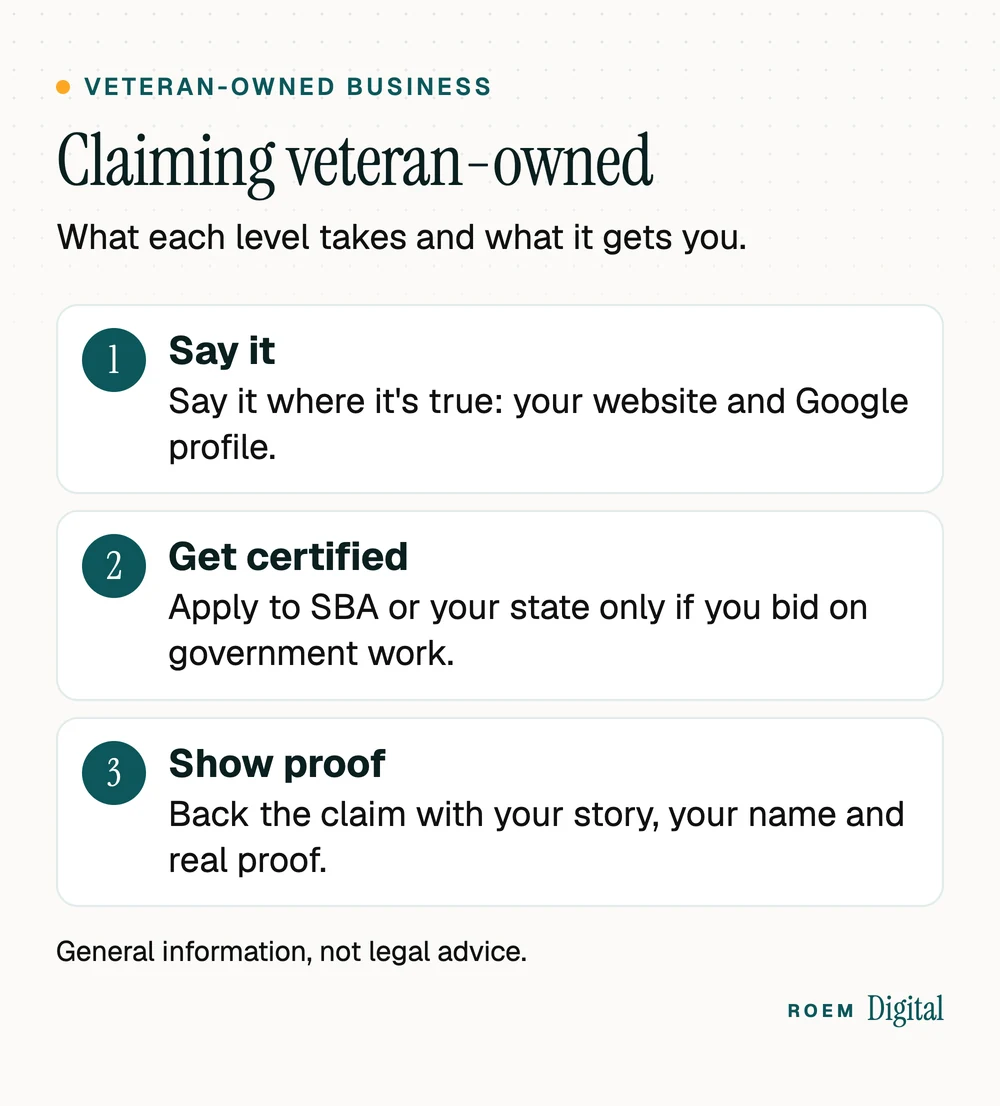
| Level | What it takes | What it gets you |
|---|---|---|
| Say it | Being veteran-owned, and saying so on your website and profiles | Recognition from customers who look for veteran-owned businesses |
| Get certified | An application to SBA VetCert or a state program, with documents | Eligibility for set-aside contracts or state vendor preference |
| Show proof | Your name, your story and real proof in your marketing | Trust that a badge alone doesn't earn |
The rule that ties the levels together: never claim a level you haven't reached. "Veteran-owned" is a fact you can state. "Certified veteran-owned" is a status someone granted, and only applies if they did. Our about page shows how we state ours.
SBA VetCert: veteran owned business certification for federal work
VetCert, the SBA's Veteran Small Business Certification program, is the federal route. The SBA says the National Defense Authorization Act for Fiscal Year 2021 moved the certification from the Department of Veterans Affairs to the SBA as of January 1, 2023. You apply through the SBA's certifications portal.
What certification gets you, according to the SBA:
- Certified SDVOSBs can compete for federal sole-source and set-aside contracts across the federal government.
- Certified veteran-owned small businesses (VOSBs) can pursue sole-source and set-aside contracts at the VA under its Vets First program.
- For those VA opportunities, certification is required. The SBA states there is no self-certification provision.
Certification also comes with upkeep. Under the program's rules in 13 CFR Part 128, a certified firm must recertify every 3 years and must tell the SBA about material changes, such as a change in ownership or control, within 30 calendar days.
The same rules say an applicant must provide documents showing that qualifying veterans own and control the business and that it's small under the size standard for an industry code in its SAM profile, and that a certified firm must keep that documentation for as long as it participates. In practice, put your ownership papers, operating agreement and VA documentation in one folder before you start, and keep it current. It makes recertification far less painful three years later.
On November 9, 2026, the SBA announced its fiscal year 2027 contracting goals, in which the agency-level goal for veteran prime contracting and subcontracting doubles from 5% to 10%. If you sell to federal agencies or their prime contractors, that's a reason to look at VetCert now. If your customers are local households, certification is optional, and your time may be better spent on the marketing steps below and on our guide to local SEO for service-area businesses.
Florida's certified veteran business enterprise program
Florida runs its own program for state purchasing. Under section 295.187 of the 2026 Florida Statutes, the Department of Management Services certifies a veteran business enterprise that:
- Employs 200 or fewer permanent full-time employees.
- Has a net worth of $5 million or less together with its affiliates.
- Is domiciled in Florida.
- Is at least 51 percent owned by one or more wartime veterans or service-disabled veterans, who also control management and daily operations.
Note the narrower test: Florida counts wartime veterans and service-disabled veterans, as the statute defines them, not every veteran. The benefit is a vendor preference. When a state agency receives bids that are equal on price, quality and service and one comes from a certified veteran business enterprise, the agency must award it to that business. If another tied bidder also holds a vendor preference under Florida law, the statute gives the award to the business with the smallest net worth. Certification has to be renewed every two years, and the business must notify the department within 30 business days of events such as a change in ownership.
Other states run their own programs with their own rules, so check your state's agency before you apply. If state agencies are a real market for you, give them their own line in your one-page marketing plan, with its own goal and its own proof, separate from the marketing aimed at homeowners or patients.
Marketing a veteran owned business without overclaiming
This is where most of the payoff is for a local business. Customers can't choose a veteran-owned business they can't find, so put the fact where people look:
- Turn on the Google Business Profile attribute. Google's help page on business attributes lists Veteran-owned among the identity attributes. You set it under Edit profile, then More, then Yes next to the attribute. Google says adding it tells everyone your business is owned by someone of that identity, that you can opt in or out at any time, and that a review of edits usually takes about 10 minutes but can take up to 30 days. Our Google Business Profile checklist covers the rest of the profile.
- Say it on your website, on the about page and in the footer, in the same words you use on Google.
- Tell the real story briefly: your name, your branch if you want to share it, and why it shapes how you work. Specifics beat slogans.
- Use a certification seal only if you hold that certification, and use it the way the issuing program allows.
- Add the fact to directories and profiles that offer a veteran-owned option, keeping the wording the same everywhere. Our guide to business listings and citations explains why consistency beats volume.

Words you can use, and when
| Phrase | Use it when |
|---|---|
| Veteran-owned | Veterans own and run the business. |
| Service-disabled veteran-owned | The owners have a service-connected disability rating from the VA. |
| Certified VOSB or SDVOSB | SBA VetCert has certified the business, and the certification is current. |
| Certified veteran business enterprise (Florida) | The Department of Management Services has certified the business, and it's renewed. |
| Military or veteran discount | You offer it to every eligible customer, with the terms written down. |
Keep the claim accurate. The FTC's advertising FAQ for small businesses states that advertising must be truthful and non-deceptive, and that advertisers must have evidence to back up their claims. In federal contracting the stakes are higher: 13 CFR 128.600 sets penalties for misrepresenting veteran-owned status to win set-aside work. And don't let the badge carry the whole message. Customers still choose on reviews, responsiveness and the quality of your work, so the veteran-owned fact works best next to proof that you're good at the job.
When to talk to a professional before you claim status
This is general marketing information, not legal advice. Talk to an attorney who handles government contracting, or a Veterans Business Outreach Center, before you:
- Bid on any contract set aside for VOSBs or SDVOSBs.
- Change ownership, bring in a partner or form a joint venture while certified.
- Rely on a family member's or caregiver's role in running the business to qualify.
- Use a certification logo or seal in advertising.
The SBA's veteran page says the Veterans Business Outreach Center program offers resources to veterans, service members and military spouses interested in starting or growing a small business. For the marketing side, our guide to questions to ask a marketing agency helps you check that whoever writes your copy will keep the claim accurate.
Why this matters to us at ROEM
ROEM Digital is veteran-owned, and it's listed as an attribute on our Google Business Profile and on our about page. We're a small senior team based in Davenport, Florida, working with clients across Central Florida and nationwide. We help owners put their story on a custom-built website, keep their Google profile and listings consistent, and track the calls and forms that follow.
The habit worth copying is one sentence about ownership, written once and used everywhere: the website footer, the about page, the Google profile and every directory listing. When the wording matches, customers and search engines read the same fact the same way, and nobody wonders which version is true.
Frequently asked questions
What is a veteran owned business?
A veteran owned business is owned and run by one or more veterans. For federal certification, the SBA requires that veterans own and control at least 51% of the business, that the VA identifies the owners as veterans, and that the business is small under its industry's size standard. State programs set their own rules.
Do I need certification to say my business is veteran-owned?
No. If veterans own and run your business, you can say it is veteran-owned in your marketing. Certification matters when you want government benefits such as set-aside contracts or a state vendor preference. Never say certified, or use a certification seal, unless a program has actually certified your business.
How do I get SBA VetCert?
Check that the VA identifies you as a veteran or service-disabled veteran, that veterans own and control at least 51% of the business, and that the business is small under the size standard for an industry code in its SAM registration. Then apply through the SBA's certifications portal. A Veterans Business Outreach Center can help you prepare the application.
How long does SBA veteran certification last?
Under the program's rules, a certified veteran-owned or service-disabled veteran-owned small business must recertify every 3 years to stay certified. It must also notify the SBA within 30 calendar days of any material change, such as a change in ownership or control, that could affect its eligibility.
How do I add veteran-owned to my Google Business Profile?
Open your Business Profile, select Edit profile, then More, find the business identity attributes and choose Yes next to Veteran-owned, then save. Google says edits are usually reviewed in about 10 minutes but can take up to 30 days, and you can opt in or out at any time.
Does Florida certify veteran-owned businesses?
Yes. Florida's Department of Management Services certifies veteran business enterprises under section 295.187 of the Florida Statutes. The business must be at least 51 percent owned by wartime or service-disabled veterans, based in Florida, with 200 or fewer full-time employees and a net worth of $5 million or less. Certification renews every two years.