Short answer: A Hispanic marketing strategy for a local business starts with knowing which customers you serve, because origin, generation and language preference vary widely. Choose Spanish, English or both from your own data, adapt messages instead of translating them word for word, and make every step after the click work in Spanish, from the phone call to the review.
The Hispanic market is many markets
A Hispanic marketing strategy for a local business comes down to four decisions: which Hispanic customers you actually serve, whether to reach them in Spanish, English or both, how to adapt your message rather than translate it word for word, and whether every step after the click works in the language the customer chose. Most plans stop at the ad. The leaks usually come later, at the phone, the form, the follow-up and the review request.
Most advice on marketing to Hispanics is written for national brands buying media. A local business has a more practical problem: making the path after the click work. That's where this guide spends most of its time. Our bilingual marketing service covers what we build in English and Spanish. Here we focus on the decisions you can make yourself, and a scored audit you can run on your own business this week.
The U.S. Census Bureau puts the Hispanic population at 70.1 million as of July 1, 2025, 21% of the country and its largest racial or ethnic minority. Florida is one of 16 states with a million or more Hispanic residents in 2025. That's a big number, and a misleading one if you treat it as a single audience.
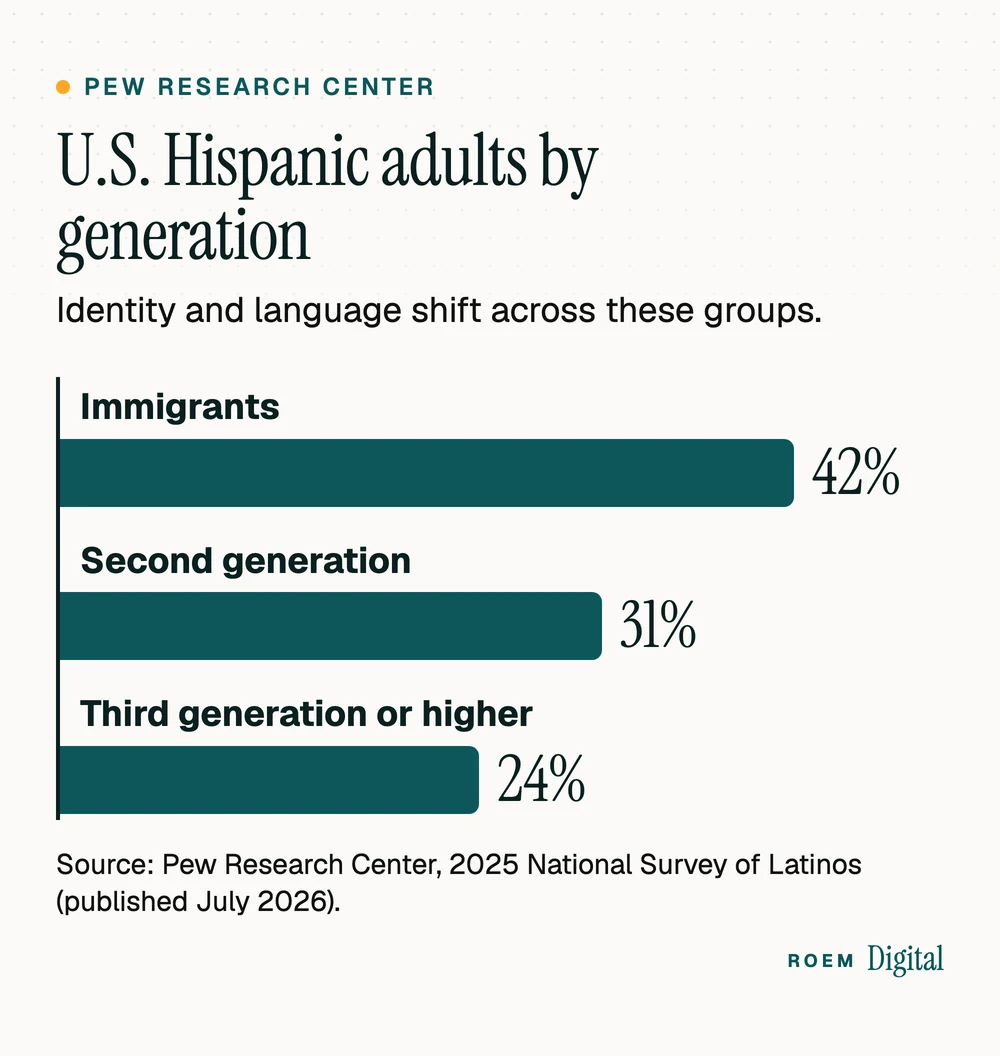
Pew Research Center's 2025 National Survey of Latinos found that about 42% of Hispanic adults were immigrants, 31% second generation and 24% third generation or higher. Identity shifts across those groups. In the same survey, 67% of Latino immigrants said they most often use a label tied to their country of origin or heritage, compared with 49% of second-generation and 34% of third- or higher-generation Latinos.
Language shifts too. In Pew's 2022 survey on Spanish use, 75% of U.S. Latinos said they can carry on a conversation in Spanish pretty well or very well, while 65% of third- or higher-generation Latinos said they cannot carry one on well. And 63% said they use Spanglish at least sometimes.
So segment by the things that change how people buy from you:
- Language preference: Spanish first, English first, or comfortable in both
- Country of origin or heritage, which shapes vocabulary and references
- Generation and time in the U.S., which Pew's data ties to both language and identity
- The service itself: ask your front desk which services draw questions in Spanish, because it's rarely all of them
Skip the shortcuts: one flag standing in for a whole region, party imagery on a page about plumbing, or a campaign that only appears during Hispanic Heritage Month. Good Latino marketing looks like your real customers, because it starts from them. Real photos of your own team and work beat stock imagery in any language, as our guide to what a local service business should post explains.
Spanish, English or both: let your customers decide
Choose the language from evidence, not assumption. The Census Bureau's 2018 to 2022 language data found that 61.0% of people aged 5 and older who spoke Spanish at home also spoke English "very well." Among Spanish speakers aged 18 to 64, the share was 58.3%, and among those 65 and older it was 41.6%. Plenty of your Spanish-speaking customers are comfortable in English. Many aren't, and your own records will tell you how many.
Look at your own customers before you build anything:
- Search Console: list the queries already reaching your site in Spanish, and which page they land on.
- Your phone and front desk: for one month, note every call or visit that starts in Spanish or switches to it.
- Forms and messages: count the inquiries written in Spanish, including ones in mixed Spanish and English.
- Reviews: check which language your Google reviews are written in, yours and your competitors'.
- GA4: check the language setting of visitors' browsers, a rough but free signal.
Then match the build to the evidence. A trickle of Spanish inquiries can start with one Spanish landing page for your main service and Spanish posts on your Google profile. A steady share calls for Spanish pages for every main service and a Spanish ad group. If a large part of your customers prefer Spanish, run the whole path in both languages. If you run a church with a Spanish service, our church marketing ideas cover the rest of the plan.

Translation vs transcreation: write the Spanish page for the reader
Transcreation means rewriting a message for another language and culture so it keeps the same intent, tone and call to action. Translation converts the words. A translated page can be accurate and still sound like a form letter.
Literal versions trip over the details customers notice. The word for a quote, for example, varies: cotización, presupuesto and estimado all show up, and the right one is whichever your own customers use. Idioms, jokes and slogans rarely survive word for word. Keep the substance identical in both languages (the offer, prices, warranties, opening times and service area), and let the wording change.
Before you publish, have a fluent Spanish speaker who knows your customers and your trade read every page out loud. If something sounds like a manual, rewrite it.
Give each Spanish page its own address
Google's multilingual site guidance recommends different URLs for each language version rather than switching the language with cookies or browser settings. It also says Google uses the visible content of a page to determine its language, so the menus, buttons and footer on a Spanish page should be in Spanish too. Google also advises against side-by-side translations, so skip the page that runs English and Spanish in two columns. Link each version to the other, and don't redirect visitors automatically based on a guess about their language. Google's guide to localized versions of a page explains the hreflang tags that pair them, with each version listing itself and the others.
Our own Spanish page for Orlando businesses works this way: its own address, linked to its English counterpart, and a plain note that our audit and calls are in English.

Google Ads and your Google Business Profile in Spanish
Two Google products need specific handling.
Google Ads. Starting in September 2026, Google is removing the campaign-level language setting for Search campaigns, according to its language targeting help page. Search ads now match on the language of the ads themselves, and Google says it prioritizes ads that match the language of the search. It also checks that the searcher understands the language of both the ad and the landing page. In practice:
- Write Spanish ads in Spanish, in their own ad groups, with Spanish keywords.
- Send every Spanish ad to a Spanish landing page, never to your English homepage.
- Bilingual searchers can still see either language, so count conversions from each separately.
Whoever runs your campaigns, make sure calls and forms are tracked before the first paid click. Our paid media service works that way.
Google Business Profile. Google's Business Profile guidelines allow one profile per location, not one per language, and don't permit repeating your business name in two languages, even if your sign does. Keep the name as it is, then use Spanish where the profile allows it: posts, service descriptions and your replies to reviews written in Spanish. Our Google Business Profile checklist covers every other field.

The language path audit: score your Hispanic marketing strategy step by step
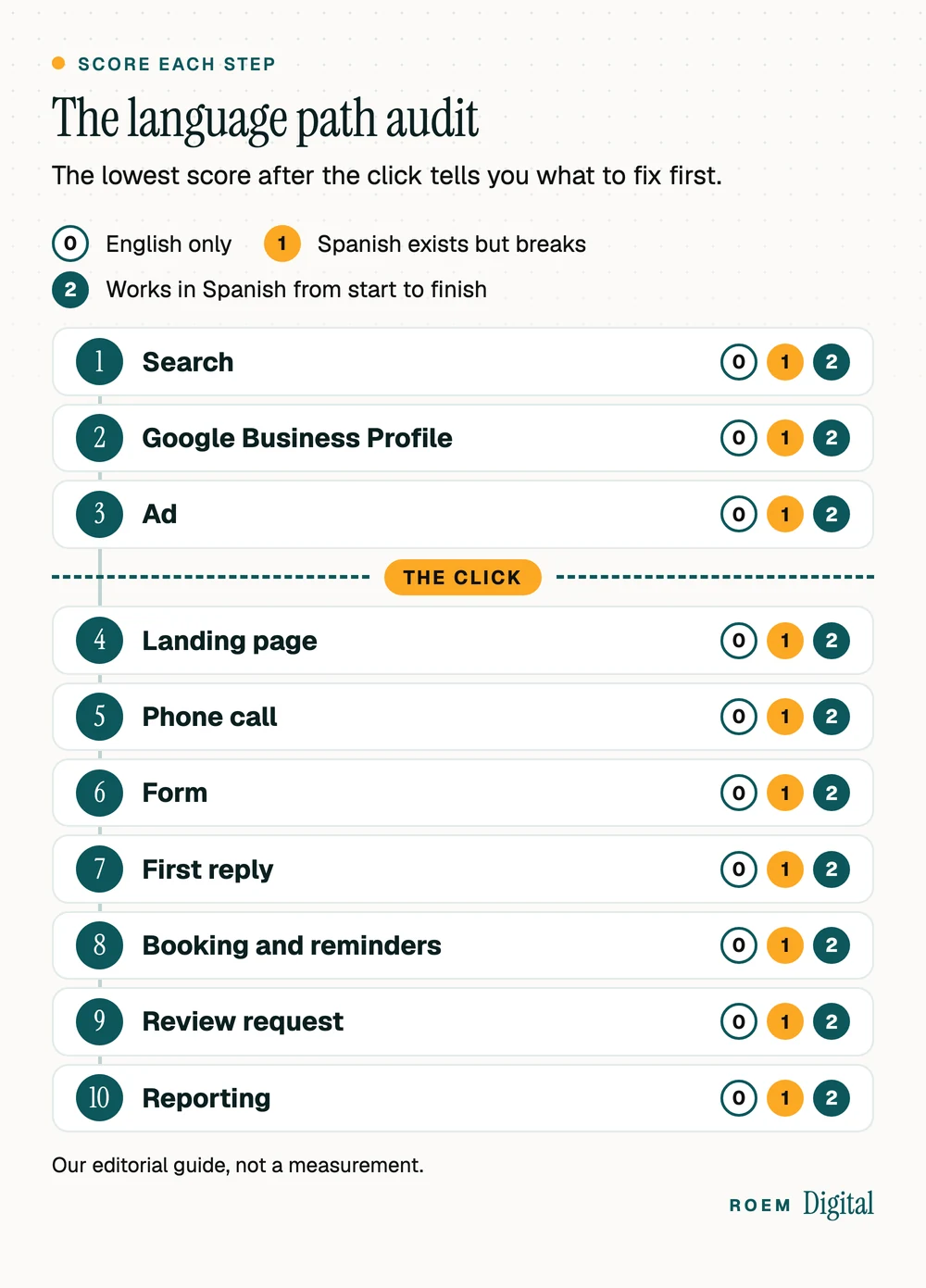
The language path audit is a scored walk through every step from a Spanish-speaking customer's first search to how you count the lead. Each step gets a 0, 1 or 2, and the lowest score after the click tells you what to fix first.
Score each step:
- 0: English only.
- 1: Spanish exists but breaks: half-translated, a dead end, or slower than English.
- 2: Works in Spanish from start to finish.
| Step | Scores a 2 when | Common break |
|---|---|---|
| Search | Spanish searches for your main services reach a Spanish page or ad | Only the homepage has a Spanish version |
| Google Business Profile | Posts, service descriptions and review replies have Spanish where customers use it | Spanish reviews get English replies |
| Ad | Spanish keywords and Spanish ad copy point to a Spanish page | Spanish ad lands on the English homepage |
| Landing page | Its own address, Spanish menus and buttons, same offer and prices | Spanish headline over English navigation |
| Phone call | Someone can help in Spanish, or the greeting says when someone can | English-only voicemail |
| Form | Labels, error messages and the thank-you message are in Spanish | Errors and confirmation appear in English |
| First reply | Comes in the customer's language as fast as an English reply | Spanish inquiries wait for "the person who speaks Spanish" |
| Booking and reminders | Confirmations and reminders arrive in Spanish | Reminder texts switch back to English |
| Review request | Sent in the customer's language, the same way to everyone | Only English speakers get asked |
| Reporting | Leads are counted by language | Spanish leads vanish into the total |
Here's the rule we'd hold to: don't buy Spanish clicks until every step after the click scores at least a 1, and the phone and the first reply score a 2. Spanish ads in front of an English-only phone line pay for the customer to hang up. The page right after the click matters most, and our guide to landing pages for Google Ads covers what it needs in any language.
Where Spanish marketing breaks: the phone, the form and the reply
Most businesses that try marketing to Hispanic consumers fix the front of the path and leave the back in English. Here's where to look.
The phone
A Spanish ad promises a Spanish conversation. If only some of your team can hold one, say so honestly in the greeting and on the page: when someone who speaks Spanish is available, and how fast you call back. A short Spanish voicemail greeting costs nothing. If nobody can, hold the Spanish ads until someone can. Call tracking logs the landing page behind each call, as our guide to call tracking for small businesses explains, so you can see whether calls from Spanish pages get answered.
The form and the first reply
Check the parts nobody sees until they submit: error messages, the thank-you message and the automatic email. Then check the reply itself. Answer in the language the customer wrote in, and hold Spanish inquiries to the same response time as English ones. Follow-up texts and emails go only to people who asked for them, in the language they chose.
Reviews in Spanish
Ask every customer for a review in the language you've been speaking with them, with the same direct link. Google's review policy bans incentives for reviews in any language. Reply to Spanish reviews in Spanish. Our guide to getting more Google reviews has the request process, and it works the same in Spanish.

What we've built in English and Spanish
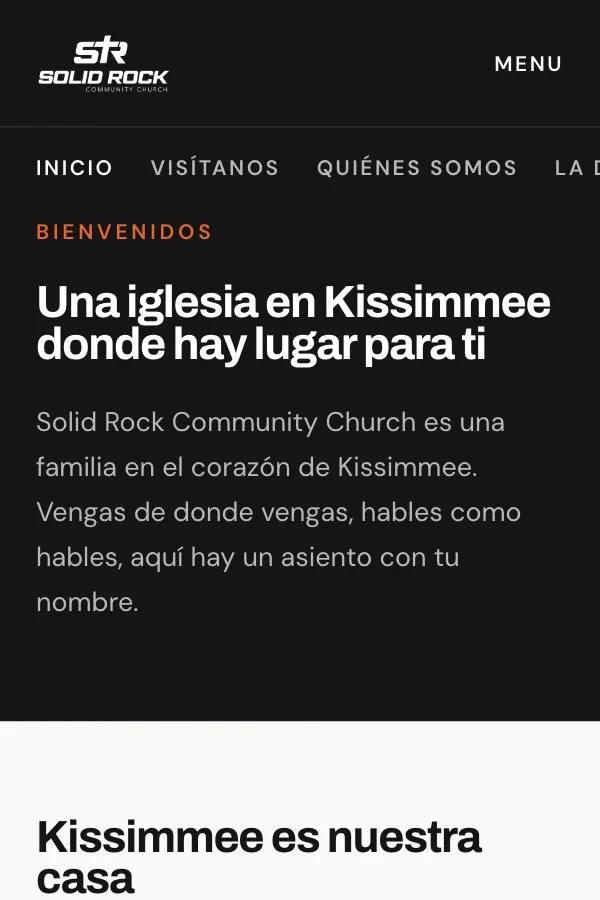
Our bilingual proof is work you can visit. We built the English and Spanish site for Solid Rock Community Church in Kissimmee, with plan-your-visit, sermons and live stream, events, ministries, a food pantry and an online Growth Track course. We also built Elizabet Maria's site in Spanish and English for her music and ministry. Both are in our client portfolio.
Every plan starts with the free audit, delivered in English, which names the few changes most likely to pay off first. You own the domain, the site and every account, and calls, forms and bookings are tracked before any ad spend starts. A good Hispanic marketing strategy grows from that evidence, one step of the path at a time.
Frequently asked questions
What is a Hispanic marketing strategy?
A Hispanic marketing strategy is a plan for reaching Hispanic customers based on who they actually are: language preference, country of origin and generation. For a local business it covers which language to use where, how to adapt messages, and making sure the phone, forms, follow-up and reviews work in Spanish too.
Should I market to Hispanic customers in Spanish or English?
Let your own customers decide. Check Spanish queries in Search Console, calls and messages that arrive in Spanish, and the language of your reviews. Census data shows many Spanish speakers also speak English very well, but not all do. Many local businesses do best with both, starting where the evidence is strongest.
What is the difference between translation and transcreation?
Translation converts the words from one language to another. Transcreation rewrites the message so it keeps the same intent, tone and call to action for readers of the other language and culture. Keep the facts identical, such as offers, prices and service areas, and let the wording change to fit how customers talk.
Do I need a separate Google Business Profile in Spanish?
No. Each location gets one profile, and Google's guidelines don't allow repeating your business name in two languages. Keep the name as it is and add Spanish where the profile allows it, such as posts, service descriptions and replies to reviews written in Spanish. Link to Spanish pages on your website where they fit.
How does Google Ads decide when to show Spanish ads?
Starting in September 2026, Google is removing the campaign language setting for Search campaigns. Search ads match on the language of the ads themselves, and Google prioritizes ads in the language of the search. Write Spanish ads in their own ad groups with Spanish keywords, and send them to Spanish landing pages.
What is multicultural marketing?
Multicultural marketing reaches customers from different cultural and language backgrounds with messages built for each group rather than one version for everyone. For a local business, a multicultural marketing strategy usually means a clear plan for each language your customers use, honest representation of the people you serve, and a sales path that works in each language.
Should I say Hispanic or Latino in my marketing?
Use the words your customers use. Both terms are common, and many people describe themselves by their family's country of origin instead. In Pew's 2025 survey, 67% of Latino immigrants said they most often use a label tied to their origin or heritage. On a local page, naming the service plainly usually matters more than the label.