
Short answer: Enrollment marketing is the work of turning interested families into enrolled ones and keeping them year after year. For a small private school, the biggest gains usually come from fixing the stages where families quietly drop out: the inquiry reply, the tour, the application, the enrollment decision and re-enrollment.
The enrollment leak map: where school enrollment marketing loses families
Enrollment marketing is everything a school does to turn an interested family into an enrolled one, and to bring that family back the next year. For a small private school, we'd argue the fastest gains rarely come from more advertising. They come from the stages after the first click, where families who already like you go quiet: the reply to their inquiry, the tour, the application, the enrollment decision and re-enrollment.
This guide maps those five stages, shows where each one tends to leak, and gives the first fix for each. It also covers open house ideas, Florida's scholarship questions and bilingual families. For the agency side (websites, local SEO, ads and tracking built for schools), see our private school marketing services.
An enrollment leak is any point where an interested family stops moving toward a seat and nobody notices. It's easy to watch only the two ends, inquiries in and students enrolled. The leak map looks at the handoffs in between, because each one asks the family for a bigger commitment than the last.
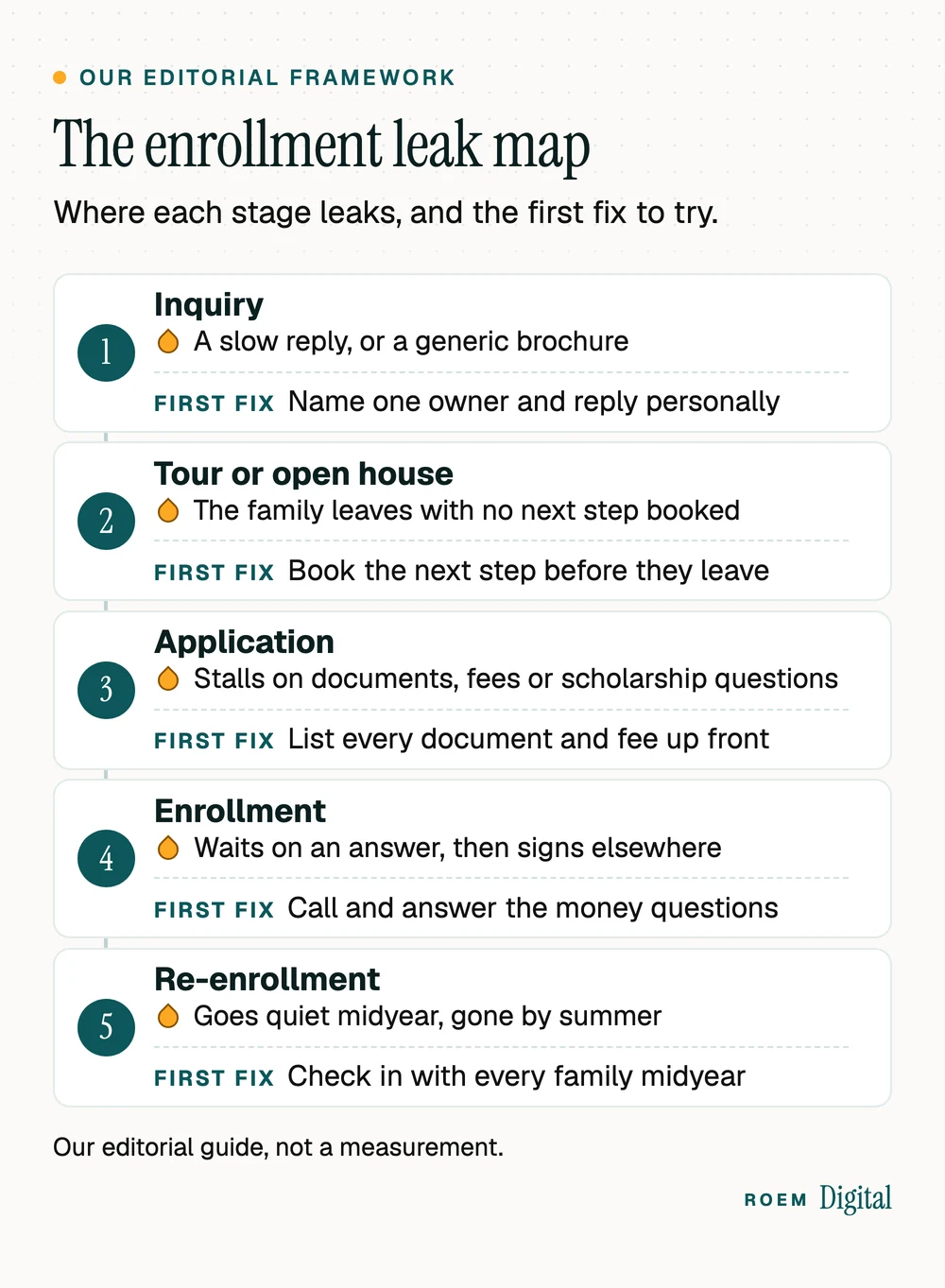
Here's how each stage tends to leak at a small school, and the first fix to try. Start with whichever stage your own numbers point to.
| Stage | Where it leaks | First fix |
|---|---|---|
| Inquiry | The form lands in a shared inbox, the reply comes days later, or the reply is a generic brochure | Name one person who owns new inquiries, plus a backup, and reply personally with two tour times |
| Tour or open house | The family visits, likes what it sees and leaves with no next step on the calendar | Book the next step before the family walks out: a shadow day, an application appointment or a tuition call |
| Application | The family starts the form, then stalls on documents, fees or a scholarship question | List every document and fee up front, and call about any application left unfinished |
| Enrollment | An accepted family waits on a scholarship, a sibling's spot or a tuition answer, then signs elsewhere | Call every accepted family, answer the money questions directly and agree on a date to decide |
| Re-enrollment | A current family goes quiet midyear and is gone by summer | Check in with every family midyear, before the re-enrollment form goes out |
The middle stages leak on paperwork and money
Applications and enrollment decisions stall for ordinary reasons: a birth certificate nobody can find, a fee nobody expected, a scholarship award that hasn't arrived, a sibling whose grade is full. None of that shows up in an ad report. Put a one-page list of documents, fees and dates on your application page and in the first email after a tour. Then give every unfinished application and every accepted family that hasn't signed a phone call from a real person, with one question: what's left before you can decide? The answers tell you which leak to fix next.
Find your biggest leak before you buy more ads
You don't need new software for a first pass. When you do look at software, our guide to choosing a student information system covers what to ask. Pull last admissions season's records, even if they live in an inbox and a spreadsheet, and work through these steps:
- Count families at each stage: inquiries, tours attended, applications finished, students enrolled and current families who re-enrolled.
- Work out what share moved from each stage to the next, and compare each rate with the season before. The stage that fell furthest, or the one that surprises you most, is your biggest leak.
- Test that stage yourself. Submit your own inquiry from a phone on a Sunday evening and note when, and how, the reply arrives.
- Fix that one stage for a month, then count again before you move to the next.
If you can't count a stage at all, that's your first fix. Our guide to tracking calls and form fills in GA4 shows how to see which inquiries came through your website and from where.
How to increase school enrollment at the inquiry stage: answer first
The inquiry is the cheapest stage to fix and the easiest to lose. A parent who fills out your form on a Tuesday night may be filling out forms for other schools the same night. A fast, personal reply with a clear next step gives you a better shot at the tour than a brochure that arrives two days later.
A good first reply:
- Uses the parent's and child's names and answers the question they asked
- Offers two specific tour times instead of "let us know what works"
- Links to your tuition and scholarship page so money questions don't stall the visit
- Comes from a named person with a direct way to reach them
- Goes out the same day, including weekends during your busiest weeks
Then tie each inquiry to where it came from. A call from your Google listing and a form from an ad are different leads with different costs, and our call tracking guide for small businesses explains how to tell them apart.

Bilingual families: run the funnel in the language they chose
If some of your families speak Spanish at home, the first leak can be the form itself. Offer the inquiry form and the tuition basics in Spanish, reply in the language the family wrote in when someone on your staff can do it well, and hold a Spanish-language session or table at your open house. Tag each inquiry by language so you can see whether Spanish-speaking families move through the stages at the same pace as everyone else. Our bilingual English and Spanish marketing service covers the pages, ads and tracking on both sides.
School open house ideas that end with a next step
An open house is a tour for many families at once, and it leaks the same way: families leave impressed but without anything booked. Plan the event backward from the one thing you want each family to do before they walk out.
- Hold it while classes are running, so families see a real morning instead of an empty room
- Let a few students show their work or lead part of the tour, with their parents' permission
- Seat two or three current parents on a short panel and let visitors ask anything
- Staff a tuition and scholarship table with the person who actually handles those questions
- Add an evening or Saturday session for parents who can't leave work
- Give younger visitors a short sample lesson while their parents talk with teachers
- Run a Spanish-language session or table if your community needs one
- Book shadow days and application appointments at the exit, not by email later
Promote it where families already look. Google's own Business Profile help on posts says an event post takes a title, start and end dates and times, and can carry an action button, so point that button straight at your sign-up page. Our Google Business Profile checklist covers the rest of the listing families see before they ever reach your website.
The next morning, send each family a personal note with the application link and the name of the person to call. Families who registered but didn't come get a different note offering a private tour at a time that suits them.
Florida scholarships: the first question many families ask
Two money questions can stall a Florida family before the tour: does this school take the state scholarship, and what will we actually pay? Your enrollment marketing should answer both before anyone books a visit.
Step Up For Students says its private school scholarships are open to Florida residents eligible to enroll in a K-12 public school, regardless of household income, through the Florida Tax Credit Scholarship Program (FTC) and the Family Empowerment Scholarship for Educational Options (FES-EO). Families apply through Step Up. The same page lists renewing students first in its priority order, and in mid-November 2026 it invited families to sign up for a notice when 2027-28 applications become available.
Step Up's page for participating private schools adds details worth building into your messages. Payments to schools happen at least four times per school year, and a parent must electronically verify each one before Step Up releases the funds. Its list of what the scholarships can pay for specifically excludes before and after school care. It also describes the Family Empowerment Scholarship for Students with Unique Abilities (FES-UA) as an education savings account for students with certain diagnoses.
What that means for your marketing:
- Put your participation and a link to Step Up on the tuition page, not only on the admissions page (our private school marketing services page covers the rest of that page)
- Show out-of-pocket costs next to the scholarship line, starting with aftercare
- Tell new scholarship families to expect a payment verification step several times a year
- Remind current scholarship families when renewal opens
- Answer FES-UA questions separately from FTC and FES-EO questions
This is general marketing information, not financial or legal advice. Rules, amounts and dates change, so families should confirm everything with Step Up For Students directly. For your school's own questions, Step Up's partner page points schools to its Customer Experience Team and names the Florida statutes behind the programs: section 1002.395 for FTC and section 1002.394 for FES-EO and FES-UA. Our companion guide on school website design shows where that information belongs on your site.
Re-enrollment: the private school marketing strategy that starts midyear
Re-enrollment isn't decided on the day the form goes out. A family that has felt unheard since October may have made up its mind long before the form arrives, and the form only makes it official. Watch for the quiet signals:
- A parent who stops opening school messages or skips conferences
- A question to the office that never got an answer
- A scholarship family that hasn't started its renewal
- A younger sibling who isn't on next year's list
Put a midyear check-in on the calendar: a short conversation with every family about how the year is going and what they're planning for next fall. Fix what you can, and write down what you can't. The same moment is a natural time to ask every family, not only the happiest ones, for an honest Google review. Our guide to getting more Google reviews by the rules covers how to ask without breaking Google's policies.
How we help small schools with enrollment marketing
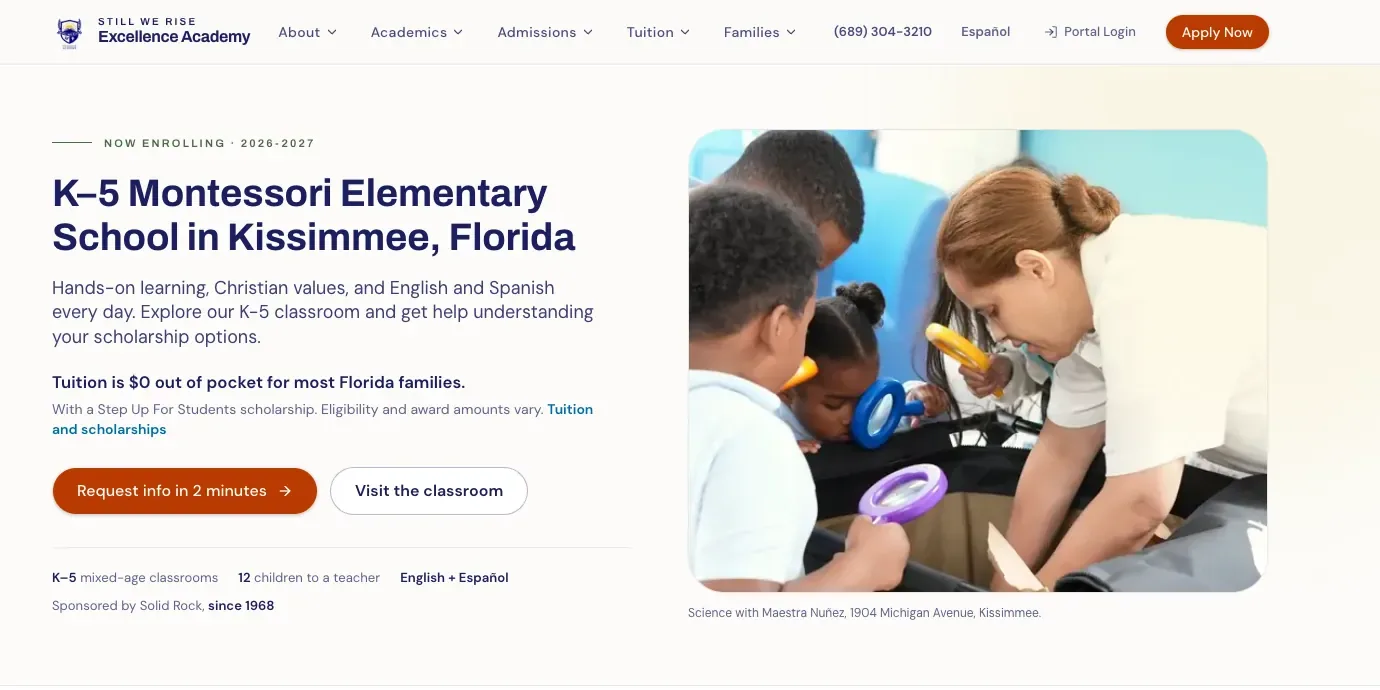
We're a small senior team based in Davenport, Florida, and our school work follows the same path, from the first search to a signed enrollment. We built the enrollment site for Still We Rise Excellence Academy, a Christ-centered Montessori school in Kissimmee, which walks families through admissions, tuition and Step Up scholarships. We also run ads for the school, and its families and staff use ROEMedu, the school SIS and LMS we built.
When we run ads, calls, forms and bookings are tracked before ad spend starts, and your school owns its domain, website, ad accounts and analytics. Read more about our private school marketing work or our website design and branding service.
“ROEM is a first class all systems partner. Their expertise extends from organizational infrastructure, communications, and digital marketing, to web design, graphic design, IT support, and so much more. Still We Rise Excellence Academy is better because of ROEM!”
Frequently asked questions
What is enrollment marketing for a private school?
It's the work of turning interested families into enrolled students and keeping current families enrolled. It includes getting found, but for a small school much of the gain comes later: replying to inquiries quickly, turning tours into applications, helping accepted families decide, and checking in with current families long before re-enrollment forms go out.
How can a small private school increase enrollment without a bigger ad budget?
Fix the stage where the most families drop out before you buy more traffic. Count last season's inquiries, tours, applications and enrollments, find the steepest drop, and fix that handoff first. A faster personal reply, a booked next step at every tour, or a midyear check-in with current families often costs nothing but staff attention.
What should happen after a family submits a school inquiry form?
A named person should reply the same day, personally, with an answer to the family's question, two specific tour times and a link to tuition and scholarship information. If the family doesn't book, follow up once more a few days later. Log the date of each inquiry and each reply so you can see how fast your school really responds.
What are good open house ideas for a small private school?
Hold it while classes are running, let current parents answer questions on a short panel, staff a tuition and scholarship table, and give children a sample lesson while parents talk with teachers. Offer an evening or weekend session for working parents. Above all, book shadow days or application appointments before families leave the building.
What should Florida private schools tell scholarship families before they enroll?
Say whether you participate, and send families to Step Up For Students for eligibility, amounts and dates. Then explain what Step Up's own pages describe: parents verify each scholarship payment electronically, at least four times a school year, and before and after school care isn't covered. Never promise an award. This is general information, not financial or legal advice.
How do you measure enrollment marketing results?
Count families at each stage for one admissions season: inquiries, tours attended, applications finished, students enrolled and current families who re-enrolled. Tie each inquiry to its source, such as Google, an ad or a referral. The numbers that matter are how many families move from each stage to the next, not clicks or page views.
Why do families stop responding after a school tour?
Often the visit ended without a booked next step, or a question went unanswered, perhaps about money, schedules or a sibling's spot. End every tour by scheduling something specific, send a personal note the next morning, and ask directly whether anything is holding the family back. A short, honest answer does more than another brochure.