
Short answer: Many churches can get Google Ad Grants, worth up to $10,000 USD a month in Search ads, but only if the IRS lists the church as a recognized 501(c)(3) or a group exemption covers it. After approval, Google requires a 5% monthly click-through rate, working conversion tracking and specific account settings.
Who qualifies: the church catch in Google Ad Grants eligibility
Yes, many churches can use Google Ad Grants. Google gives eligible nonprofits $10,000 USD of in-kind advertising each month for text-based ads on Google Search. For a U.S. church, eligibility usually comes down to one question that trips up many churches: does the IRS list your church as a recognized 501(c)(3), or does a group exemption cover it? After approval, the account has to meet Google's rules every month, or Google can deactivate it.
This guide covers Google Ad Grants for churches from start to finish: who qualifies, a readiness check before you apply, the application, the ongoing rules, and how to turn free clicks into Sunday guests. It's general marketing information, not legal or tax advice.
Ad Grants sits inside Google for Nonprofits, so your church qualifies for that first. For the United States, Google's Google for Nonprofits eligibility guidelines say organizations must be registered with the IRS as exempt under Section 501(c)(3), or be a group exempt organization with proven affiliation to a central nonprofit that has 501(c)(3) status.
This is where churches get caught. Under IRS rules, churches that meet the 501(c)(3) requirements are automatically considered tax exempt and don't have to apply for recognition. That means a church can be tax exempt without ever applying. Google addresses this directly. Its page on tax exempt organizations in the U.S. says organizations must obtain recognition of 501(c)(3) status from the IRS, and those not listed in the IRS's online publication of tax exempt organizations aren't eligible.
So when it comes to Google Ad Grants for churches, a church can be fully tax exempt and still fail the first check. The IRS notes that many churches seek recognition anyway, because it gives leaders, members and donors reliance that the church is recognized as exempt. Find your church's situation below:
- The church has its own IRS determination letter. Confirm it appears in the IRS Tax Exempt Organization Search under the same legal name and EIN you'll give Google.
- A denomination's group exemption covers the church. Google's page on group exempt and chapter organizations says you must supply your own EIN plus documents showing the group exemption number and your affiliation with a central organization that has 501(c)(3) status.
- The church is a campus or branch of a larger church. If it uses the parent church's exemption, Google says it must use the parent's 501(c)(3) documents and be officially recognized as a branch by the central organization.
- The ministry is fiscally sponsored. Organizations without their own 501(c)(3) status that aren't covered by a group exemption aren't eligible.
- The church has neither. It isn't eligible today. Whether to seek IRS recognition is a question for a professional (see the section near the end).
Google's list also excludes government entities, hospitals and health care organizations, and schools, though charitable arms of health care organizations and philanthropic arms of educational organizations are eligible. And Google's terms say grantees must be organized and operated exclusively for charitable purposes. Our church marketing page gives the short version of these rules.

The Four Gates: a readiness check before you apply
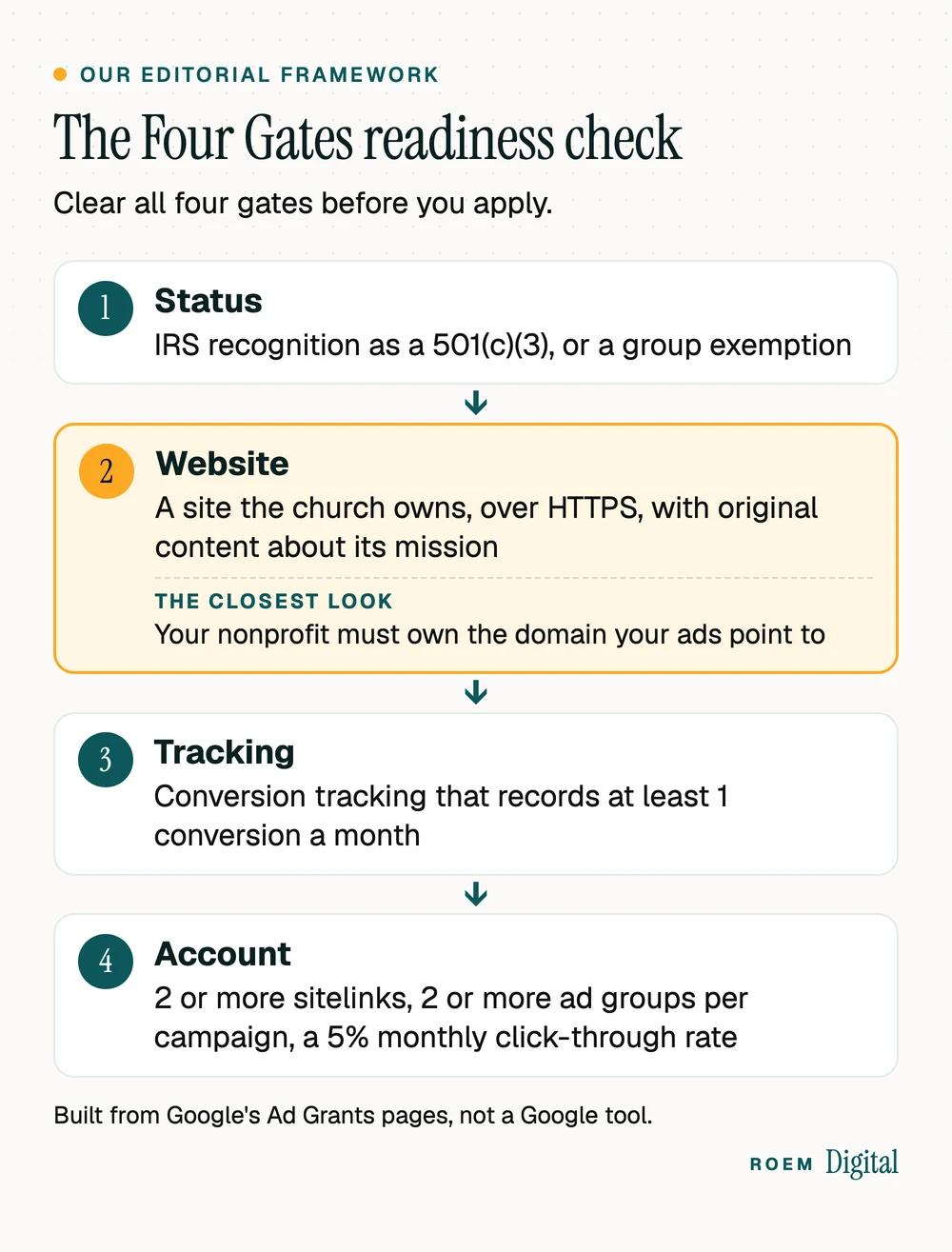
Run this four-part check before you start a Google Ad Grants application. It's our editorial framework, built from the Google pages linked in this guide, not a Google tool. A church that clears all four gates before applying is better placed to keep the account active.
| Gate | What Google requires | You're ready when |
|---|---|---|
| 1. Status | IRS recognition as a 501(c)(3), or a group exemption tied to a central 501(c)(3) | The church appears in IRS Tax Exempt Organization Search under the name and EIN you'll submit, or you have your own EIN plus the group exemption number and proof of affiliation |
| 2. Website | A site the church owns, served over HTTPS, with substantial original content about its mission | Service times, ministries, mission and contact details live on real pages, not PDFs or placeholders |
| 3. Tracking | Conversion tracking that records at least 1 conversion a month | A plan-your-visit form, an online connect card or a call counts as a conversion, and you've tested it |
| 4. Account | Local geotargeting, 2 or more sitelinks, 2 or more ad groups per campaign, conversion-based bidding, a 5% monthly click-through rate | Someone has time to review the account every month |
Gate two deserves the closest look. Google's Ad Grants website policy says your nonprofit must own the domain your ads point to, and that domain can't redirect visitors to a donation portal or a social media page. The site needs a significant amount of original content about your mission and activities, a secure HTTPS connection and no AdSense ads, and Google's checklist asks you to show your physical address and EIN, or an annual report. A .org address isn't required. Speed and mobile layout count too, and our guide on whether a slow website is costing you visitors shows how to test yours.
Gate three needs to work before launch. If your site has no form or tracked call yet, set that up first with our walkthrough on tracking calls and form fills in GA4.
How to apply for Google Ad Grants as a church
The application has two parts: verification for Google for Nonprofits, then activation of Ad Grants. Each Google for Nonprofits product is activated separately.
- Gather the church's legal name, official address and EIN. For U.S. applicants, Google asks for an Employer Identification Number from your IRS records, found on your determination letter, tax filings or official registration documents.
- Pick the Google account carefully. Google requires the same username for Google for Nonprofits and Ad Grants, so use an account the church controls, not a volunteer's personal Gmail. Our guide to who owns your marketing accounts explains why that matters later.
- Request a Google for Nonprofits account at google.com/nonprofits and enter the church's registered name, address and EIN.
- Watch your inbox. Google's verification partner, Goodstack, checks your details against official registries and may email from verifications@mail.goodstack.org asking for documents. Google says most requests are reviewed in 2 to 14 business days.
- Once verified, activate Ad Grants. Google's activation guide has you confirm your website meets its policy, enter the site, watch a short welcome video and submit the request. Don't create a Google Ads account yourself during activation. Google provides one.
- When the account arrives, build your first campaign and set up conversion tracking before you spend much of the grant.

The Google Ad Grants requirements that keep a church account active
Approval is the start. Google's Ad Grants account management policy and policy compliance guide set the rules below, and any account in violation is subject to automatic suspension without notification.
| Rule | What Google's pages say |
|---|---|
| Click-through rate | Accounts not exclusively using Smart campaigns must keep a 5% CTR each month at the account level. Missing it 2 months in a row means temporary deactivation. |
| Conversion tracking | Valid tracking that records at least 1 conversion per month. Time on site and homepage visits must be excluded from Conversions. |
| Bidding | Accounts created on or after April 22, 2019 must use Maximize conversions, Maximize conversion values, Target CPA or Target ROAS, unless they use Smart campaigns. |
| Location | Specific geotargeting. Organizations that mainly serve their local community, and Google names houses of worship, should show ads only in their town or local area. |
| Structure | At least 2 sitelink assets, and at least 2 ad groups per campaign. |
| Keywords | No single-word keywords (your own brand terms and a few others are exceptions), no overly generic keywords, no keywords with a Quality Score of 1 or 2. |
| Survey | Respond to Google's annual program survey. |
On bidding, the rule is conversion-based bidding on every campaign, and Google says campaigns that don't comply are subject to automatic bid strategy changes. In its steps for reinstating an account deactivated over bidding, Google adds that you can begin with Maximize clicks to gather data, then switch as soon as you have enough conversions. On campaign types, Google's Ad Grants campaign setup guide offers Search or Performance Max. It says grant Search campaigns run only on eligible Search inventory, Performance Max may not serve on all inventory, and the daily budget can be up to 329 USD across all campaigns. Google's click-through rate requirements page adds two details: accounts aren't reviewed for the 5% rule until they're 90 days old, and Smart campaigns are exempt from it, so they remain an option for an account that can't reach 5%.
Keywords need regular attention. "Church" on its own is a single-word keyword, and Google's mission-based campaign rules also rule out names of places on their own. Phrases with intent and place, like "nondenominational church in Davenport" or "food pantry open Saturday", fit the rules better. To lift a low click-through rate, Google's compliance guide says to pause high-impression, low-CTR keywords until the filtered total reads at least 5%. Our negative keywords guide covers cleaning up the search terms behind those numbers.
If an account falls out of line, Google's process is the same each time: fix the issue, then request reinstatement. Google decides whether to reinstate it.

From grant clicks to Sunday guests
Free clicks don't help anyone if they land on a homepage written for members. The most useful way to run Google Ad Grants for churches is to treat each campaign as an invitation to one next step, and to measure that step.
- One campaign per purpose. Sunday visits, a Spanish service, the food pantry, a youth night, Easter. Each gets its own ad groups and its own page.
- A check before promoting a recovery ministry. Grant accounts must follow standard Google Ads policies, and ads for drug or alcohol recovery support fall under Google's addiction services policy, which restricts them to advertisers who apply and are approved.
- A page that matches the ad. Someone searching for a Saturday food pantry should land on the pantry page with its schedule and address. Our guide to landing pages for Google Ads explains message match.
- A conversion that's a real step. Google's list of meaningful conversions includes membership registrations, volunteer sign-ups, information requests and calls to your organization. For a church, that might be the plan-your-visit form, a pantry sign-up or a call to the office.
- Sitelinks for a guest's questions. Google's setup guide describes sitelinks as links to specific pages on your site, not your homepage. Service times, kids, plan your visit and location are natural choices.
- A tight map. If your church serves one town, target that town. It's what Google asks of houses of worship anyway.
- A real welcome. Reply to every form within a day or two. The grant pays for the click, and the welcome brings people back.
For follow-up ideas that turn a first visit into a second, see our church marketing ideas by guest stage. Our paid media and lead generation service covers ad campaigns, landing pages and tracking if your team needs help with those pieces.

When to talk to a professional instead
This guide is general marketing information, not legal or tax advice. Talk to a CPA or attorney who works with churches before you change anything about the church's legal or tax setup to qualify for a grant, and especially when:
- The church has never received an IRS determination letter and you're weighing whether to apply for one.
- The church shows up on the IRS Automatic Revocation of Exemption List. The IRS says some churches appear on that list because its records don't identify them as churches.
- You aren't sure a denomination's group exemption covers your congregation. Your denomination's central office is the place to ask for the group exemption documents Google wants.
- A ministry runs through a fiscal sponsor or as a separate legal entity from the church.
If Goodstack rejects the application, Google's help page on Goodstack verification points you to Goodstack's appeal form for a re-review. This is general marketing information, not legal or tax advice. If your questions are about the website or tracking side instead, a free marketing audit is the simpler place to start.

Frequently asked questions
Can churches get Google Ad Grants?
Yes, if they meet Google for Nonprofits eligibility. In the United States, that means IRS recognition as a 501(c)(3) or coverage by a group exemption tied to a central 501(c)(3) organization. A church that never sought IRS recognition and isn't covered by a group exemption isn't eligible under Google's current guidelines.
How much is the Google Ad Grant worth to a church?
Google offers eligible nonprofits up to $10,000 USD a month in Search ads, and its setup guide allows a daily budget of up to 329 USD across all campaigns. How much a church actually uses depends on how many people nearby search for what it offers and how well its ads meet Google's rules.
Does a church need a 501(c)(3) letter for Google Ad Grants?
Google's U.S. guidelines say organizations must obtain recognition of 501(c)(3) status from the IRS, even though churches are automatically tax exempt without applying. The other route is a group exemption: your denomination's central organization holds 501(c)(3) status, and you provide your own EIN plus proof of affiliation.
What is the 5% CTR rule for Google Ad Grants?
Grant accounts that don't use Smart campaigns exclusively must keep a click-through rate of at least 5% each month, measured across the whole account. If the account misses it two months in a row, Google temporarily deactivates it until you fix the problem and request reinstatement.
Can a church use Google Ad Grants for YouTube or display ads?
Not in the usual way. Google describes Ad Grants as text ads on Google Search, and grant Search campaigns run only on eligible Search inventory. Performance Max is allowed, but Google says it may not serve on all inventory in grant accounts. For video, Google for Nonprofits offers a separate YouTube Nonprofit Program.
How long does Google Ad Grants approval take for a church?
There are two reviews. Google says most Google for Nonprofits verification requests take 2 to 14 business days, and the Ad Grants activation review can take several business days after that. Watch for emails from Goodstack asking for documents, because an unanswered request stalls the review.
What happens if a church's Ad Grants account breaks the rules?
Google can pause problem keywords automatically, temporarily deactivate an account that misses a requirement, and suspend accounts in violation without notification. You fix the issue, such as a low click-through rate, missing conversion tracking or missing sitelinks, then request reinstatement. A monthly review helps you catch problems first.